
Why I Was (Partially) Wrong About AI Talent Inflation
Published:
After two years of “All-in AI”, my deep-seated belief in the “10,000-hour talent moat” was ruthlessly shattered by the rise of Agentic workflows.
Author: Koutian Wu; GitHub: ktwu01
Six months ago, I posted a framework I called “AI Talent Inflation”, arguing that the “10,000-hour rule” would soon create an unbridgeable gap in the AI industry. My empirical belief was straightforward: early adopters who went “All-in” on AI in 2022 would hit their 10,000-hour mastery milestone by late 2025 or early 2026. I predicted this would lead to an exponential divergence in capability, leaving “outsiders” permanently behind, and that the “democratization of AI” was a myth.
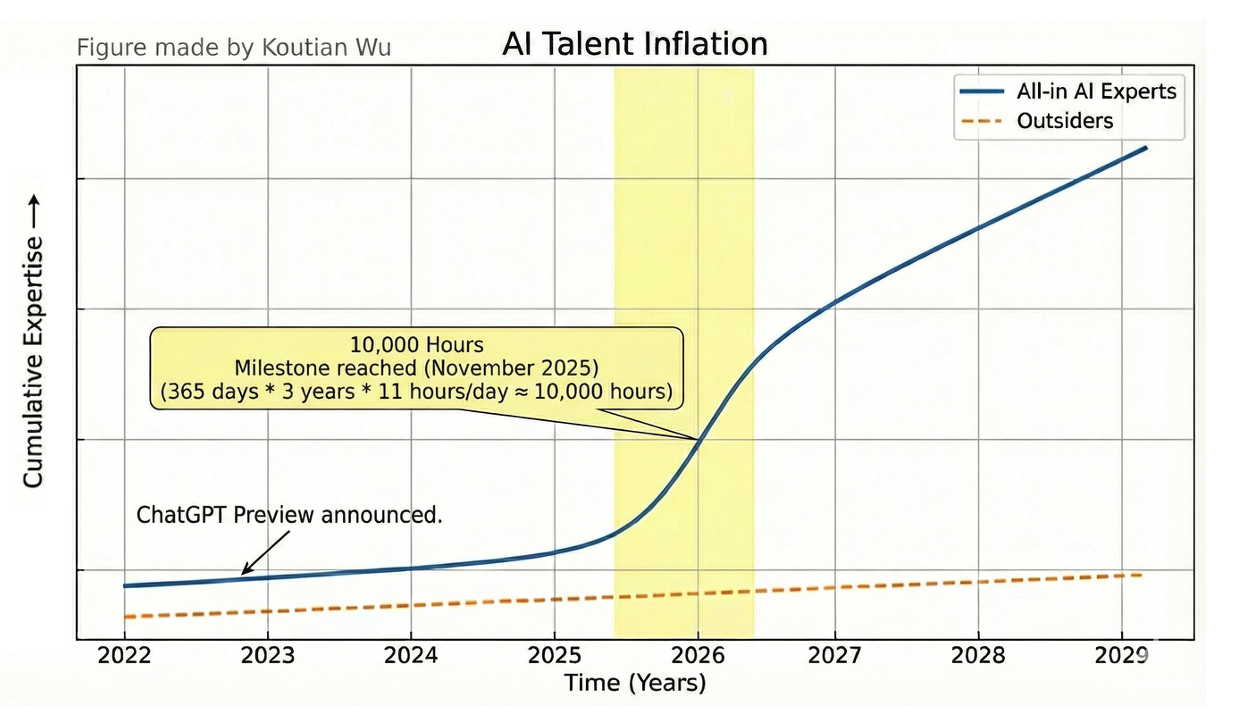
Today, looking back from mid-2026, I have to admit I was partially wrong. The divergence I predicted did not materialize across the board—it split sharply between AI Infrastructure and AI Applications.
I was right about the AI Infrastructure layer. In the world of pre-training, fundamental model architecture, and deep systems engineering, the talent inflation is very real. If you don’t already have a basic understanding and years of grueling, compounding experience in this specific domain, the barrier to entry remains incredibly high and difficult to breach. The 10,000-hour rule holds true here.
However, I was entirely wrong about the AI Application layer. Here is why I changed my mind: I fundamentally misunderstood where the compounding value of those 10,000 hours would accrue for builders. I assumed human practitioners needed to accumulate that expertise to stay relevant in building AI products. Instead, the AI models absorbed it directly.
The rapid evolution of agentic workflows and deeply integrated AI reasoning engines effectively abstracted away the need for specific “AI technical mastery” at the application layer. The tools became so capable that the technical barrier to entry collapsed from underneath us. Today, an “outsider” with strong domain knowledge and clear intent can build applications that would have required a dedicated AI engineering team just months ago.
At the application level, the “democratization of AI” wasn’t a myth; it was just waiting for the models to cross a critical capability threshold. We didn’t get a new class of untouchable application builders based on technical hours logged. Instead, the technical moat evaporated, and the real differentiator shifted back to where it always should have been: taste, domain expertise, and the ability to solve actual human problems.