
Is Google Using All the Elements?
Published:
A model name in some evaluation data stopped me cold this week, and the name was Gemini 4 Argon.
Author: Koutian Wu; GitHub: ktwu01
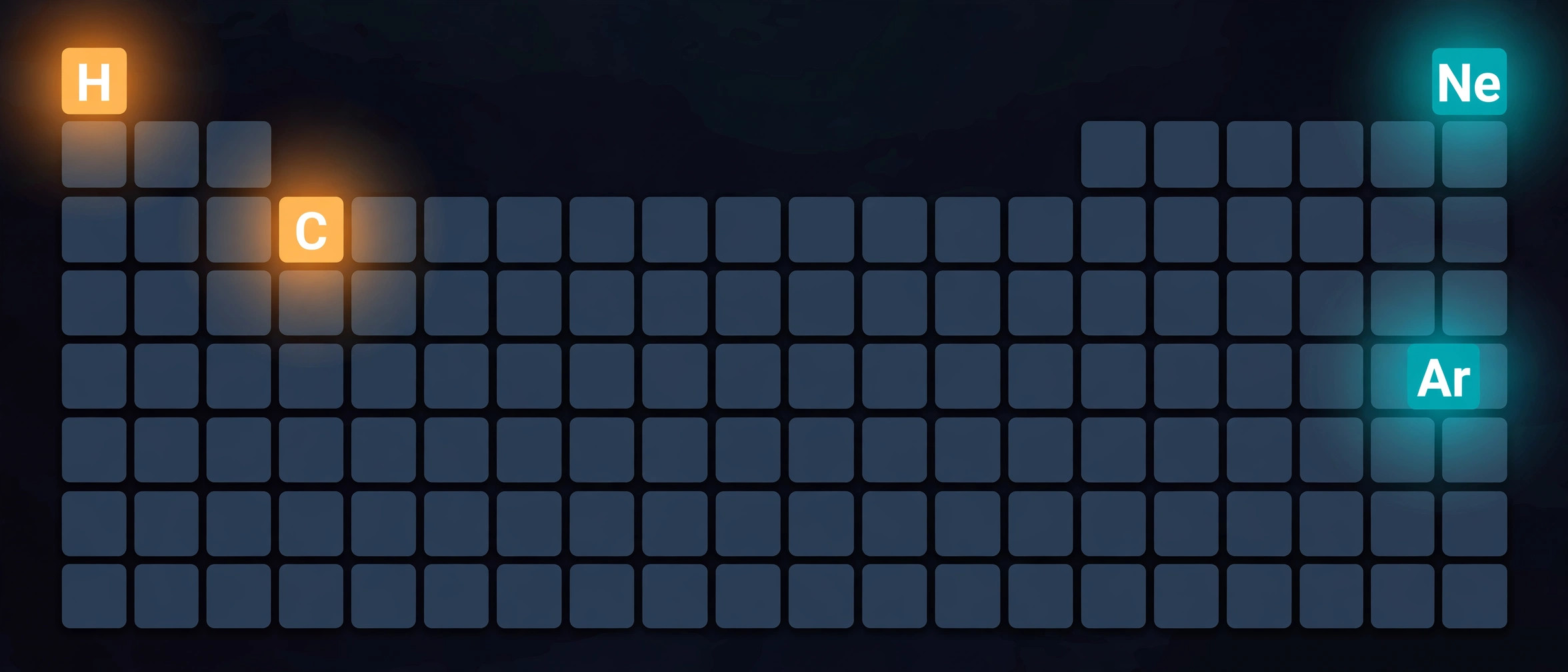
I run Benchmark Radar, a project that collects benchmark records from all over the AI world, so model names cross my desk by the thousand. Most of them are forgettable, a version number here, a size label there. Argon is not a size label. Argon is element 18 on the periodic table, a noble gas. So I went and read the rest of the Gemini 4 family, and the pattern jumped straight out. Hydrogen. Carbon. Neon. Argon. Google is naming its AI models after chemical elements.
This is an old habit at Google, by the way. Chromium is element 24, a hard and shiny metal, and Google named its open source browser project Chromium. The browser the whole world uses, Chrome, grew out of that project. The periodic table has been sitting in Google’s naming drawer for a long time. The AI models are simply the newest thing pulled out of it.
Let me walk through the four names one at a time, because each one is a small decision somebody at Google actually made.
Hydrogen, element 1. The lightest thing there is, and the most common element in the universe. If you are naming the model that goes first, that is a confident pick.
Carbon, element 6. The backbone of every living thing we know of. All of organic chemistry is built on carbon. Depending on how the atoms arrange themselves, carbon gives you a diamond or a pencil lead, which is a range most products would be proud of.
Neon, element 10. The gas in the signs. Neon is famous for glowing orange inside a tube and for refusing to react with almost anything it meets. Beautiful, stable, and a little aloof.
Argon, element 18. Another noble gas. Roughly one percent of the air you are breathing right now is argon, and it does almost nothing, chemically speaking. Quiet, stable, and everywhere at once.
Now look at the numbers, 1, 6, 10, and 18. They do not climb in any order that maps onto power, and nothing Google has published says a heavier element means a stronger model. So the table is not a ladder here. Nobody gets promoted from Neon up to Argon. The names sit side by side, not one above the other.
That might be exactly the point. Element names carry a science identity without any effort, and they come as a ready made vocabulary, 118 names deep, that no naming team has to invent. Compare that with the usual ladder style of model names, where every label is a promise about rank. Rank promises start colliding with each other within a year or two, and then the names need footnotes. An element never needs a footnote. Argon is argon, it was argon before Google existed, and it will still be argon long after this model generation is retired.
Here is the part I keep turning over. Naming is never just naming. A company that names its models after elements is telling you it sees those models as raw materials, the basic stuff that other things get built from. And a periodic table is finite, public, and ordered. Anyone on the outside can watch which boxes get filled in, and in what order, and start guessing at how the company maps its own product line on the inside. If the picks follow a system, the names leak the system. If the picks are random, that leaks something too, just a different thing.
So the question I keep coming back to is a simple one. Google is clearly using the elements. How many of them does it plan to use, and what happens when the good ones run out? There are 118 boxes on that table, and some of them hold names that nobody can pronounce on the first try. Give it a few years, and we will find out how brave Google really is.