Genes, Evolution, Wisdom, Transmission, Love, and the Future
Published:
Today, alumnus Pan Jianwei sent his spiritual genes (his name) beyond the Earth.
Author: Koutian Wu; GitHub: ktwu01
On September 11, the University of Science and Technology of China held the naming ceremony for “Pan Jianwei Star”: asteroid 470341 was officially named “Pan Jianwei Star.” From now on, there is a star in the sky bearing his name. News report
Yes, I prefer to call this thing spiritual genes. It is not just a name; it is a gene.
Since ancient times, humans have loved to multiply their lineages, found their own schools, and spread their genes as far as possible — especially men. Women prefer to select the finest genes.
My family has worked in teaching for many years. Years ago, I actually looked down on the profession. I didn’t quite understand the joy of “students all over the world,” or the joy of “a house full of children and grandchildren.” But immersed in it over the years, I have come to feel more and more that this kind of happiness is real.
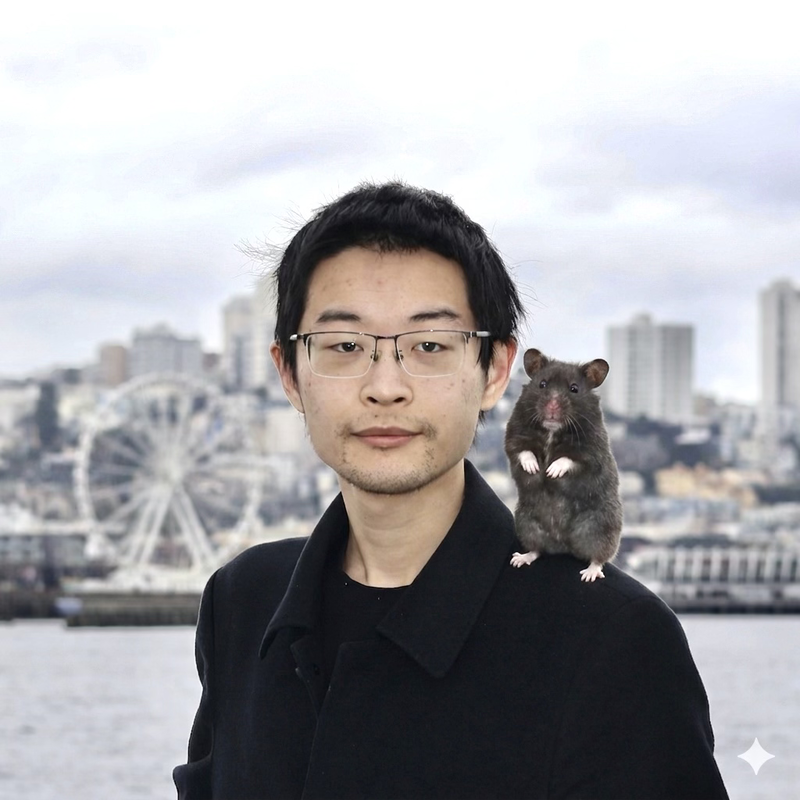
I have always believed that when you find your genes carried on by someone better than you and still growing — whether a child, a student, or even your cat — you can die without regret. You get to watch it keep growing, watch what you passed down change in them, even grow abilities you never had yourself. Hamsters don’t count, of course. Not even one named Artificial superintelligence.
Knowledge, influence, wisdom — they all spread like genes.
I was thinking this afternoon: having someone name something after my family name or given name would be a tremendous honor. Even a building — if it bore my name, I would be thrilled.
So you see, in this sense, whether it is Musk quietly having children everywhere, Telegram founder Durov, or my “born to teach” academic advisors — they are all tremendously successful (not only in the worldly sense, but in evolutionary history).
What the ancients called establishing virtue, establishing words, and establishing deeds — and even the anthem of Tsinghua, the self-styled “world’s greatest university,” “establish virtue, establish words, ask not east or west” — all say the same thing from evolution’s point of view.
From information theory’s point of view, the harder something is to destroy, the more robust the information it carries. For example, if what you beget is a person, what you beget is more robust than a student you teach.
Leaving a 10,000-star open-source project on GitHub might be more interesting than teaching your cat to do a backflip. But if you teach your cat the backflip, post the tutorial on Xiaohongshu, 10,000 people watch it, and 1,000 of them go home and teach their own cats — that is probably far more meaningful than 10,000 GitHub stars. The same backflip travels from your one cat to a thousand cats in other people’s homes.
A Google login whose UI is well made — comfortable, saving a hundred million people one second each — may be worth more than a hydrology paper with 10,000 citations.
One level down: those PR contributors leaving comments all over GitHub and contributing to open-source projects everywhere are, in a sense, cyber sperm donors. And in a sense, the site maintainers are like the endometrium / the egg, blocking the lower-quality sperm from getting in.
You may enjoy an earlier piece of mine, “Is Contributing on GitHub Like Donating Sperm?”.
And actually, I have been running an open-source project on GitHub lately. Seen from the egg’s perspective now — from the female’s perspective — you have to reject low-quality suitors. Rejecting people yourself is genuinely a strange new vantage point; I don’t usually see things this way. I used to think about how to spread my stuff outward; now I am starting to feel what is worth letting in.
We can go bigger: in the world to come, what will matter most? What could matter more than money? Maybe not energy, not money — and not energy either. Definitely not gold, since we won’t be on a gold standard; and not necessarily Bitcoin. It might just be genes. Who can say?
Turning it back on myself: what should a person do to die without regret?
Lately I have been talking with many friends about all this — the meaning and value of life, the meaning of existence. Your so-called $1M and $1B are all void once you die! Why not leave more influence in the world?
It doesn’t have to be worldly success — there is also family beside you. When you think back on your life, you can count the people who love you, the days you spent together, and feel you didn’t live in vain. Family members who spent a lifetime with you remember how you spoke and how you acted when things happened; maybe when teaching their own children, they will casually mention what you once taught them. That is how spiritual genes get passed down.
Yes — every person who loves me and whom I love has left an indelible mark on me. Why doesn’t that count as a kind of spiritual gene exchange?
There is also something very practical here: you cannot keep postponing time with family until after you’ve made enough money. After $1M comes $10M, after $10M another zero — but your family’s time doesn’t grow with your savings. The kind of influence you want to leave often requires you to be present today.
That brings me back to the naming wish. Trump has turned it into a business: from hotels to golf courses, the Trump name appears across his companies’ ventures; even the use of his name and likeness can be arranged through licensing agreements. You can see it in the company website and the public trademark license agreement. That is turning a person’s name into something that keeps spreading and being reused.
Justin Sun’s case is even more interesting. In 2024, he spent about $6.2 million on Comedian — the artwork of a banana taped to a wall — and later ate the banana at a press conference in Hong Kong. AP report. The banana is gone, but the news keeps circulating, and his name circulates with it. This is buying transmission with money: the money is spent in exchange for a story other people enjoy retelling.
Musk aims further. SpaceX has publicly set out to make humanity a multiplanetary species, building the conditions for long-term life on Mars. His 2016 talk was about exactly this. Seen through our spiritual-genes lens, what he wants to send outward already includes the whole of human civilization. If that goal is realized, the influence he leaves will enter the lives of people born later — even those who never heard his talk.
I am drawn to influence at that scale. The thought that what one person does could keep affecting so many people after his death is genuinely thrilling. But one more question to myself: if I chase fame all my life and, at the end, my family only remembers me as always absent, would I be content?
Maybe I first need to figure out what I hope others will get from me. After being remembered — then what? Is being remembered by name the same kind of satisfaction to me as someone living better because of me?
My friend YCao says the book that influenced him most is Plato’s Republic. So let me consult Plato.
GPT Astra tells me Plato actually wrote something very close to “spiritual genes.” In the Symposium, Socrates recounts Diotima: people pursue continuity through childbearing, and also conceive wisdom and virtue in the soul, making poetry, education, and laws their offspring. Works and students can carry a person’s spiritual genes onward too. The joy of “students all over the world” — someone thought exactly this two thousand years ago.
The love spoken of here is Eros in Greek. In Diotima’s account, love is the desire for the good — and the desire to possess the good forever. When you meet something beautiful, you want to draw near, want it to stay in your life, and want to keep it afterward too.
But humans die — how can we possess forever? Her answer is “giving birth in beauty,” in body and in soul. Finite life lets what it treasures continue by bringing forth new life and new thought. Love is thus tied to the longing for immortality. The “why” here can be chased all the way down to: knowing we will vanish, we still wish the beautiful to remain. Symposium, 206a–209e
This helps me understand better why loving someone changes you. You start caring about her feelings; you rethink things you used to take for granted. Spending long enough together, some of her habits and ways of seeing the world become part of you. As I said before, everyone who loves me and whom I love has left a mark on me — and that mark follows me, shaping how I treat others afterward.
Wisdom is in this too. Diotima also describes the ascent of love: from one beautiful body, gradually recognizing beauty in souls, institutions, and knowledge, until reaching Beauty itself. Love drives one to seek knowledge, because he knows he does not yet have wisdom, yet already yearns for it. Symposium, 204a–b, 210a–212a
Following this line, I feel love also changes what I want to pass down. At first I thought about putting more of my name, more of my genes, into the world. Later, I also wish the people I love to live well — even if they go places I never went and live lives completely different from mine. What I teach them, they can keep revising, revising it better than I did. I rejoice in their future, even if one day that future no longer includes me.
In Book I of the Republic, the question goes one step further. The old man Cephalus says that as death approaches, people start recalling whether they owe anyone anything. He values wealth because it helps one repay debts and avoid cheating others out of need, facing death with a calmer heart. Socrates presses on: is telling the truth and settling debts enough to be called justice?
I find that question powerful. You can list how much money you made and how many people you influenced, but those numbers don’t answer how this life was actually lived. Once a person holds great influence, what do the people around him become? Do those who follow him gain more of their own judgment, or grow ever more dependent on him?
If I took “how to die without regret” to Socrates, I think he would first ask whether I have seriously examined what I am pursuing. In Plato’s Apology, he rebukes the Athenians: why care so much for wealth, honor, and reputation, yet so little for wisdom, truth, and the improvement of the soul. He would not even trade away philosophical questioning for his life.
Applied to myself: when I say I pursue influence, have I thought about why it is worth trading my life for?
For a long stretch I sank into an existential crisis.
Back then I watched Wang Zhiwen’s TV dramas, including Black Ice. Why does Guo Xiaopeng, played by Wang Zhiwen, deal drugs? Because he enjoys the pleasure of controlling other people’s fates. And controlling other people’s fates is also a kind of controlling other people’s genes.
Existentialism hands the question back to yourself. In Existentialism Is a Humanism, Sartre’s “existence precedes essence”: man first exists, then becomes something through his own actions. Life’s meaning must be made with real choices.
He also gives the student’s dilemma: join the Free French in England, or stay and care for his dependent mother? A greater public cause on one side, a concrete person on the other. Sartre holds that no ready-made universal rule can choose for the young man. He must choose himself — and bear the choice.
I think family beside you and influence in the world cannot simply be ranked by headcount. For one particular person, your company may change his whole life. Spending time on the greater cause has its price too. Time is finite; you must own your choice. Dying without regret may just mean looking back and still being willing to live it this way.
Once that is clear, many things can start now. A fun idea from a chat with friends — write it down, let more people see it. A project you find worth doing — build it into something others can use and build on. After teaching a student, give him room to explore on his own. If he later goes further than you, even disagrees with you — that is exactly the sign you taught someone with his own judgment.
Family works the same way. If you want more time with them, set the time aside. The meal you can share today doesn’t have to wait until the project is done. If only at the very end you discover that what you wanted most was these already-missed days — what use then are the millions and tens of millions?
I also wonder: if people keep using what I made but forget my name, would I accept that? I think I would. Having my name on it would delight me; and if later users no longer even know who made it first, while what I made still shapes them — thinking of it, I feel my spiritual genes have already traveled far.
A quick plug: this is my 180+ star open-source project: Benchmark Radar. Everyone is welcome to come donate cyber sperm.