
52,867 Benchmarks, and Half of Them Are Already Dead
Published:
Most AI benchmarks you trust are already dead, they just have not stopped moving yet.
Author: Koutian Wu; GitHub: ktwu01
On Sunday, November 29, I am giving a talk about exactly that. It is hosted by the Cohere Labs Open Science Community, and Prahitha Movva invited me after finding Benchmark Radar, the living map of AI evaluation I lead. The talk runs from 12 to 1 PM Central Time, online on Google Meet, and you can sign up on Luma to get the join link.
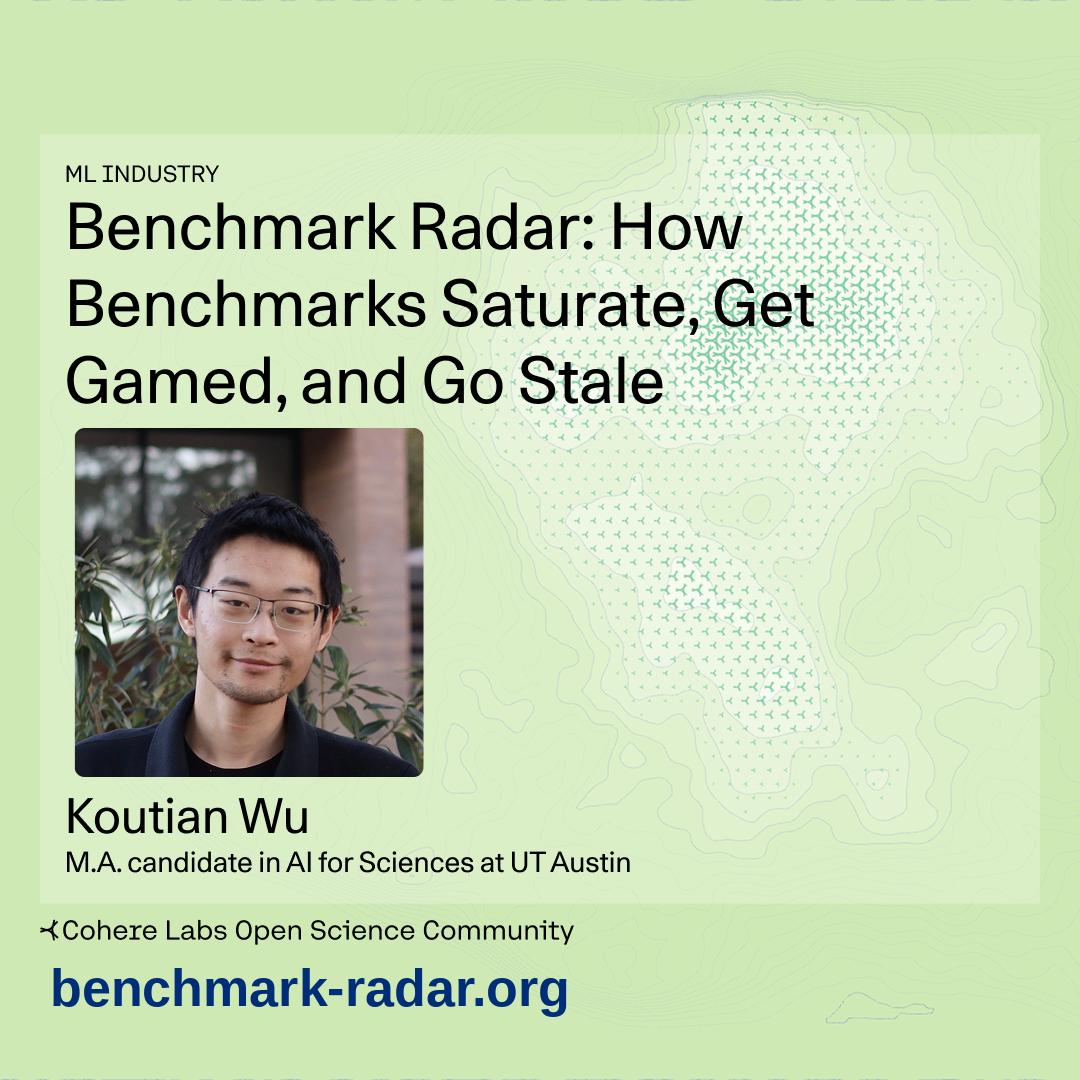
Benchmarks die in three ways, and I have watched all three happen in the data. They saturate, the frontier models bunch up at 95 percent and the test stops telling anyone anything. They get gamed, and not always by cheating, a research team at UC Berkeley reached near 100 percent on several agent benchmarks without solving the tasks at all, just by working the graders. And they go stale, the questions stay the same while the world moves on, so a high score slowly turns into a history lesson.
I started keeping the map because I kept citing benchmark scores in my own research and then finding out the test had quietly changed underneath the number. Radar now holds 52,867 records from 41 sources, and keeping that map alive is most of what I do. In the talk I will walk through the ugliest cases I have, including SWE-bench Verified, which hit 80.9 percent in February 2026 and then got retired by OpenAI after an audit found that most of its hardest problems were flawed. I will also show the six levels of benchmarks, from a 30 second quiz item up to the question of how much of real paid work any benchmark covers at all. That last number is the one that stays with me. About 90 percent of working hours in the US have little or no benchmark coverage. We are measuring a thin slice of work and arguing about it like it is the whole economy.
The last part of the talk is personal. This year I moved from the Ph.D. track to the M.A. track, and I graduate in December. I am not going to give advice about that, advice is cheap and usually wrong for the person hearing it. Instead I will read out the questions I actually asked myself while deciding. Questions travel better than advice. You can take them home and point them at your own situation, whatever it is.
If you build evals, run evals, or just enjoy arguing about leaderboards, come spend an hour with us. Bring the benchmark you trust the most. I will try to convince you it is dying, and you can try to convince me it is not.
Sign up here, Luma event page. See you on Sunday.