
How I “Reasonably” Ended Up in the Wrong NEXUS Line at YVR
Published:
I ended up in the wrong NEXUS line at Vancouver International Airport. By the rules, the mistake was mine. By design, it was an almost predictable wrong turn.
Author: Koutian Wu; GitHub: ktwu01
On July 19, 2026, I arrived in Vancouver on Air Canada flight AC20 from Singapore and connected at YVR to Austin, Texas. At about 8:07 a.m., I had completed U.S. preclearance and entered the departures area for U.S.-bound flights. My next flight was scheduled for 1:00 p.m., but its gate had not yet appeared on the departure screens.
What upset me was not that a U.S. Customs and Border Protection officer told me I was in the wrong line. It was that even after going through the experience, I still could not answer a basic question: if I encountered the same signs for the first time again, what information would tell me which way was correct?
The apparently simple fork in the route
I followed the USA Connections route from my international arrival and passed through security. Immediately afterward, I reached a fork. The main information visible to me was:
- On the left, a sign marked
E Gateswith a yellow E, but no U.S. flag and no mention ofUSA Connections. - In the middle,
NEXUS / Global Entryappeared in prominent type alongside U.S. government visual branding. - Nearby, a smaller sign read
USA Passports. - Within my field of view, there was no equally clear sign for
Visitors / Visa Holders / All Other Passports. - Between the security checkpoint and the CBP officer, I did not see an Air Canada or YVR employee available to ask.
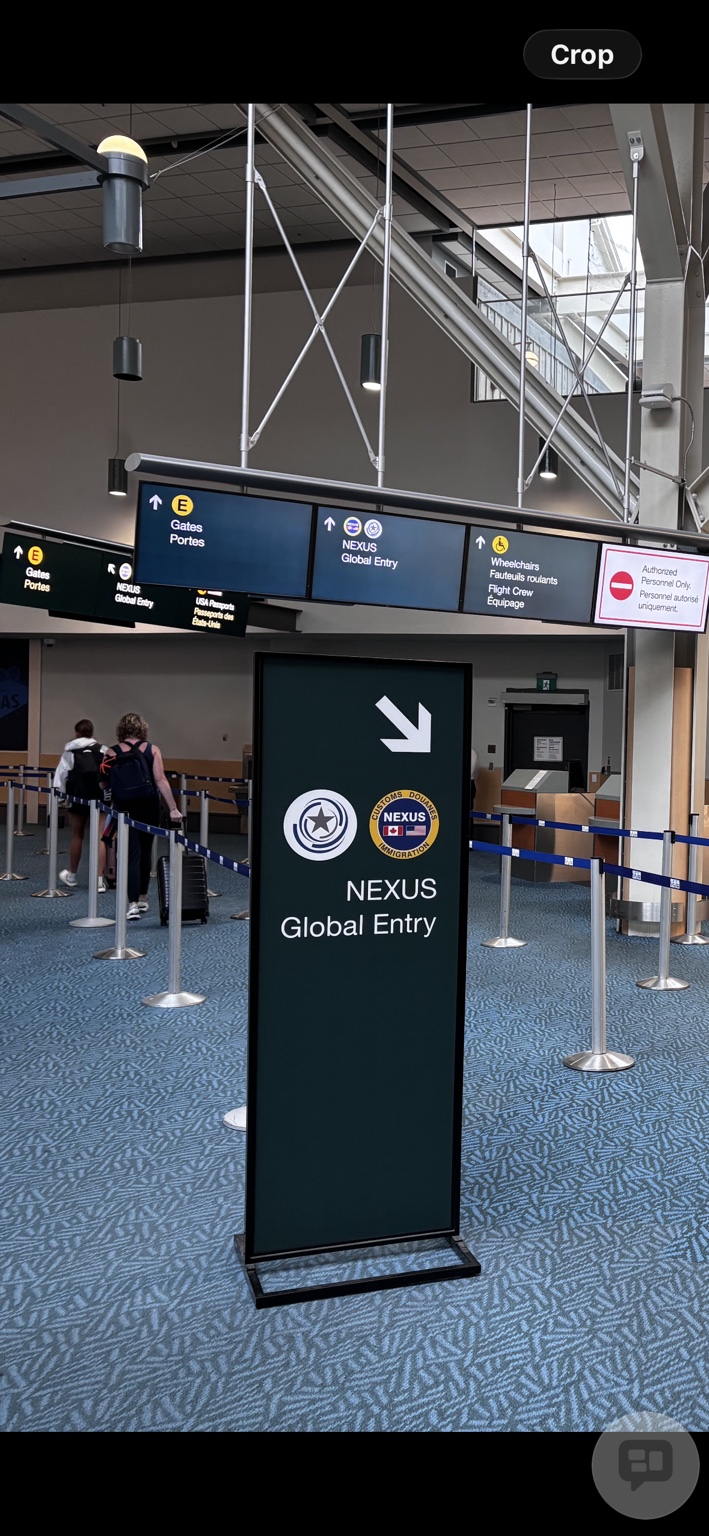
The signs visible from where I stood: E Gates had no U.S. flag, while NEXUS / Global Entry carried prominent U.S. government visual elements. The photo shows only my view at the time and does not establish that no other signs existed elsewhere in the area.
Looking back, E Gates referred to the airport’s E concourse, not electronic immigration gates. Passengers connecting from international flights to U.S. flights proceed into the U.S. preclearance area. Air Canada’s official connection guide says that international passengers connecting to the United States should follow USA Connections, clear security, and then join the U.S. immigration queue.
But the fork itself did not communicate any of that.
How elimination led me to the wrong line
I do not hold a U.S. passport, so USA Passports clearly did not apply to me.
I also did not know my departure gate. When I saw E Gates, my natural question was: if my gate has not been assigned, how can I know that I should go to E? The sign had neither a U.S. flag nor the words U.S. Preclearance or USA Connections. It gave a first-time international traveler no confirmation that all ordinary U.S.-bound passengers should go that way, even before they know their specific gate.
The most prominent remaining option, and the one with U.S. visual cues, was NEXUS / Global Entry. With USA Passports beside it, I interpreted the signs as two routes into the United States: one for U.S. passport holders and perhaps NEXUS for everyone else entering the country.
There was another important detail in my reasoning. After passing through security, I had forgotten, or more precisely, the space did not remind me, that everyone continuing from that point was already headed to the United States. That may be obvious to someone familiar with YVR. It is a hidden premise for someone who has just stepped off a flight from Singapore, is connecting through Canada to the United States for the first time, and still has no assigned gate.
So I entered the NEXUS line.
The CBP officer asked whether I had NEXUS. I said I did not know. He replied, “If you don’t know, why did you go to NEXUS?” I explained that I did not know my gate and was reluctant to follow E Gates. I also knew I could not use USA Passports, which left the NEXUS route. The officer told me not to go the wrong way next time.
By the rules, he was right. NEXUS and Global Entry are trusted-traveler programs that require an application, screening, and approval. They are not general queues for anyone with a valid U.S. visa. But telling someone not to make the same mistake does not change the conditions that produced it. If the signs and staffing remain the same, another first-time traveler who does not know these acronyms could follow the same reasoning.
The officer was right, and the system still failed
An airport cannot prevent every possible misunderstanding. A good wayfinding system, however, should do more than make sense to people who already know the answer. It should help the travelers most likely to make a mistake eliminate the wrong options quickly.
This experience resembled a real-world interface bug:
- The system used internal categories such as E concourse, NEXUS, and Global Entry before answering the traveler’s main question: where should a non-U.S. passport holder with a U.S. visa go when connecting to a U.S. flight?
- The correct
E Gatesroute lacked a clear U.S.-bound cue, which could make travelers hesitate when their gate had not yet been assigned. - The incorrect
NEXUS / Global Entryoption carried the strongest U.S. visual cues, but did not showApproved Members Onlywith equal prominence. - No staff member was visible at the point where help mattered most. By the time a traveler could ask someone, they were already in front of a CBP officer and the mistake had already happened.
That raises stress for travelers and transfers a wayfinding problem to CBP. To the officer, this was one person in the wrong line. To the airport, it should be a repeatable error path.
How these signs could be improved
The airport would not need a complex redesign. Several low-cost changes could reduce wrong turns:
- Add
All U.S.-bound passengers / USA Connections: U.S. PreclearancebesideE Gates. - State clearly:
Proceed even if your departure gate has not yet been assigned. - Add a U.S. flag or the same
USA Connectionsvisual treatment used earlier in the route. - Place
Approved Members OnlybeneathNEXUS / Global Entrywith equal prominence. - Provide a separate sign for
Visitors / Visa Holders / All Other Passports. - Put an employee, help button, or intercom at the first decision point after security.
- Test the signs with international travelers who have never visited YVR, not only with people who already know the airport.
Good wayfinding is not merely technically accurate text. It makes the correct action obvious even under pressure.
One wrong turn reveals whom the system expects to understand it
I accept that I was not eligible to use the NEXUS line. Next time, I will look for Visitors, All Other Passports, or ask an employee. I do not accept reducing the entire problem to “passengers should not go the wrong way.”
A first-time traveler does not inherently know that E is the U.S. departures concourse. They do not inherently know that NEXUS is a membership program. After a long-haul flight, they may not remember what every earlier step in the route implied. When a system treats that knowledge as a default, it will keep producing passengers who appear careless.
At a major airport, entering the wrong line is not a moral failure. It is a human-factors problem that can be observed, documented, and fixed. A clearer sign, the words Approved Members Only, or one person stationed at the right place would cost less than making travelers and CBP officers resolve preventable confusion at the inspection counter.
I have already sent YVR my photos from the airport and suggestions for improvement. Its official customer-service page lists customercallcentre@yvr.ca and 604-207-7077; YVR also says that customer-care staff and Green Coat volunteers are available around the clock. For that reason, I hope the airport checks more than whether help exists somewhere in the terminal. It should ask whether a first-time international connecting passenger can actually get help at this specific fork, within this specific field of view, before making a decision.
Update: YVR Responded Promptly
I submitted my feedback at 8:56 a.m. on July 19. About 52 minutes later, YVR created case SR1333471 and forwarded my comments to the relevant departments. The following day, Andrew Song from YVR’s Guest Experience team confirmed that my six suggestions had been shared with the appropriate teams and would be included in future assessments of signage and passenger flow.
That response time deserves recognition. Only about one day passed between my report and a substantive reply from a named staff member. YVR not only acknowledged the message but also created a formal case, reviewed the details, and specifically addressed my six suggestions.
Changes to airport signage require assessment, design, approval, and coordination across multiple teams. They cannot reasonably be completed within two or three days. YVR’s prompt and specific response already shows that documenting a problem and submitting clear, actionable suggestions can produce a formal response.
I appreciate the YVR Guest Experience team’s attention to this report. I look forward to the relevant teams completing their assessment and, where appropriate, improving the signs at this decision point for future first-time international connecting passengers.
Apart from this wayfinding fork, my overall experience with U.S. preclearance at YVR was fine. The entire preclearance process did not fail; one critical decision point failed to explain the correct path.
The same connection at YVR also gave me several observations unrelated to wayfinding, including the apparent age distribution around me, the lack of spaces designed for work, and the visible differences between people in Vancouver and Texas. I recorded those in a separate post: Another Side of Vancouver Airport: Age, Workspace, and the People I Saw.
References:
- Air Canada: Connecting through Vancouver from an international flight to the U.S.
- YVR: Information and Assistance
- U.S. Customs and Border Protection: NEXUS, General Information
- U.S. Customs and Border Protection: Global Entry FAQ
Language: