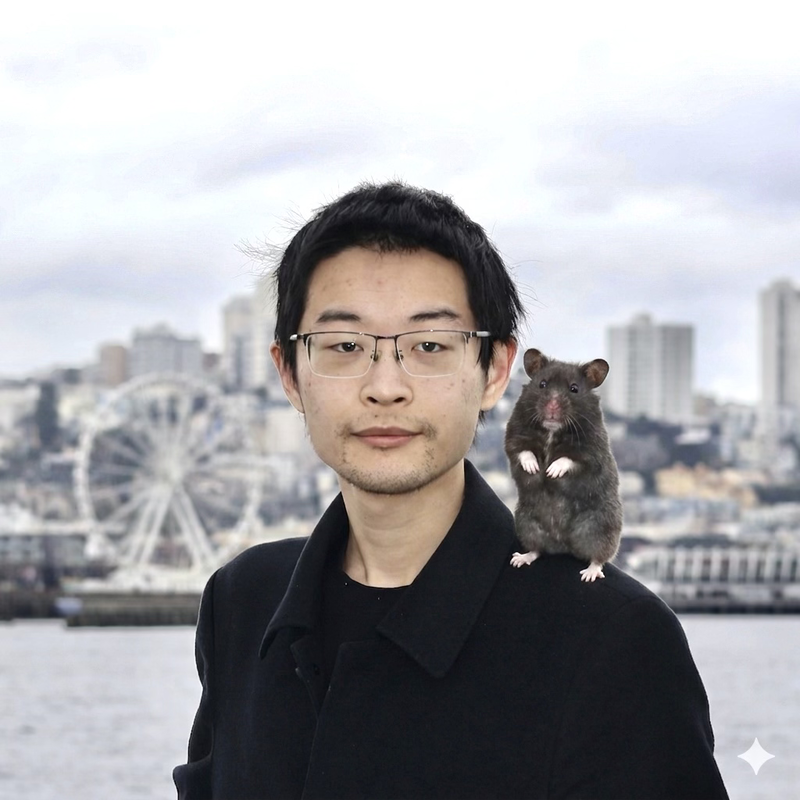
How Rich Is Chen Ning Yang? His wealth and the science of scientific privilege
Published:
A 1957 Nobel prize cheque, a father who was the first Chinese PhD in number theory, three different monetary regimes, and seventy years of compounding, so how do you put a number on Chen Ning Yang’s family wealth in 2026 without making it up?
Author: Koutian Wu; GitHub: ktwu01
All 6 figures in this post (Figure 1 through Figure 6), including matplotlib scripts, raw CSV data, and reproduction instructions, are open-sourced at github.com/ktwu01/yang-zhenning-wealth-figures. After
git clone, runmake allto reproduce all 6 figures in one shot.Companion animated chronicle (timeline + map + sources): ut01.github.io/chen-ning-yang-chronicle. A separate blog companion to the chronicle walks through how the family tree turned out to be the load-bearing structure of his biography.
中文版:杨振宁先生到底有多少财富?
A disclaimer first. I am writing this post out of genuine curiosity about the scientific ecosystem and the sociological machinery behind it, and out of deep respect for Professor Yang. As someone trained in physics, Yang was once an almost godlike idol to me. As an undergraduate at the University of Science and Technology of China (USTC), every time a midterm or final exam was looming, I would not only touch the foot of the full-body bronze statue of Guo Moruo on campus, I would also walk over to the No.2 Teaching Building and rub the smiling cheek of Yang Zhenning’s bust to pray for safe passage. Later, when I was setting up a poetry society at the school, what kept echoing in my head was that passage from his speech at the 1957 Nobel banquet about Chinese culture:
“As I stand here today and tell you about these, I am heavy with an awareness of the fact that I am in more than one sense a product of both the Chinese and Western cultures, in harmony and in conflict. I should like to say that I am as proud of my Chinese heritage and background as I am devoted to modern science, a part of human civilization of Western origin, to which I have dedicated and I shall continue to dedicate my work.”
I love Chinese culture in the same way. Precisely because he influenced me, and my generation of physics students, so deeply, I want to push past the rumors flying around the Chinese internet and use the lens of a working researcher to seriously examine: behind a scientific achievement as towering as Yang Zhenning’s, how does real capital and resource actually operate?
Questions
Before I throw out a final number, I want to step back and list a series of key questions. These will help us systematically evaluate Yang Zhenning’s wealth composition and his background. I will answer them one by one, hoping to present a fuller picture behind the numbers. As I pulled on this thread, Chen Ning Yang, his father Yang Wuzhi, and the broader Yang family, I quickly realized the interesting part is not the final dollar figure. The interesting part is the questions you must ask before you are even allowed to estimate one. Most casual takes skip that step and just guess.
So here is the question list. Before we get to any concrete answer, we have to confront these questions directly.
How much is Chen Ning Yang worth today, in 2026, in RMB/USD purchasing-power equivalent terms?
Should we count only his personal net worth, or the broader Yang family estate including his father’s legacy and the extended family?
What even counts as an asset for a scientist whose primary capital has always been intellectual? Tsinghua faculty housing, honorary positions, royalties, speaking fees, stakes in foundations that bear his name, equity in the prestige economy that does not show up on any balance sheet?
When his 1957 Nobel prize money arrived, what was it actually worth that year in USD, in RMB, and in the local purchasing power of Princeton, New Jersey in 1957?
Then come the three algorithm questions I keep coming back to.
Algorithm 1, history rank to current rank to current CNY. If a 1957 Nobel laureate ranked in roughly the top 0.0001 percent of global earners that year, and you project the same percentile onto 2026 income distributions, what number falls out? Is that even a fair thing to do for someone who never lived a top 0.0001 percent lifestyle?
Algorithm 2, history value to buying power to current value. If you deflate forward by US CPI, by Chinese CPI, by gold, by Big Mac index, by Shanghai housing index, which deflator is the least dishonest? They will give wildly different numbers. The choice of deflator is a value judgment dressed up as a calculation.
Algorithm 3, other state-of-the-art methods. Is there established economic history machinery for this, MeasuringWorth style, Williamson style, and where do those assumptions break when the subject is an academic income trajectory rather than a merchant or a tradesman? If we drop the rigid price index and instead run a financial compound model using the S&P 500 with dividends reinvested from 1957, what does that prize money become today? Does that pure capital-market algorithm explain the bulk of his wealth?
How do you handle the discontinuity of Yang moving between three monetary regimes, pre-reform RMB, Hong Kong dollar during his CUHK years, and US dollar across Stony Brook and the IAS at Princeton, without double counting or under counting?
Now the family side. Who exactly was Yang Wuzhi?
What did it mean in early 20th century China to be the country’s first PhD in number theory?
What was the Yang family’s actual class position in 1922 when Chen Ning was born, landlord, scholar-gentry, salaried professor, something else entirely?
Does growing up inside the Tsinghua faculty compound count as wealth in the same sense as inherited capital, or is it a different category entirely, call it credentialed proximity. I keep thinking about this one. It is not the same thing as money. It is also not nothing.
How much of Yang’s trajectory, Southwest Associated University during the war, then Chicago under Fermi, was downstream of his father’s professional network rather than the family bank balance?
When Yang remarried in 2004, what does the estate planning actually look like? For a scientist with adult children from a first marriage and a much younger second spouse, how do dynastic considerations enter the picture? Where exactly are the “estate distribution rumors” flying around the Chinese internet wrong?
Now zoom out. The bigger questions.
Does family wealth enable scientific careers, or do scientific careers generate wealth, or both at once, or neither in any clean direction?
If you pulled the father’s occupation for every physics Nobel laureate since 1901, what fraction would be professors, doctors, engineers, vs. farmers, factory workers, shopkeepers? My gut says lopsided. That is also why we must ask these structural questions before doing the accounting.
What fraction of Nobel laureates were children of other Nobel laureates or national academy members? Is the dynastic effect in science actually larger than in law, medicine, or business, or do we just notice it more because the science version comes wrapped in a story about meritocracy?
Does Merton’s Matthew effect, that recognition accrues to those already recognized, have a wealth analogue where lab budget access compounds over a career the same way citation count does?
For scientists who really did come from poor backgrounds, Faraday, Ramanujan, the textbook examples, what was the actual mechanism that punched them through? Patronage, scholarship, one specific advocate, sheer luck? And are those mechanisms still operative in 2026, or have they quietly atrophied while everybody assumed they were still working?
Now the literature question.
Is there a Science of Science literature that has actually measured this pipeline, family wealth to laureate, with real data instead of vibes?
Are Nobel laureates all on the same academic family tree? If you trace doctoral advisors back generation by generation, do they ultimately converge on a few common ancestors?
What do the SciSci heavyweights, Dashun Wang, Albert László Barabási, Santo Fortunato, Roberta Sinatra, have to say specifically about socioeconomic background as a predictor of scientific output, as opposed to productivity metrics in isolation?
Has anyone actually published a panel dataset of Nobel laureates’ parental income, occupation, and education, controlling for country and era?
Which venues run this kind of work, Nature Human Behaviour, PNAS, Scientometrics, Quantitative Science Studies, and which of them have actually published wealth background analyses as opposed to just productivity correlations?
Do the post-2020 papers using LinkedIn, ORCID, or institutional registries finally give us a finer-grained read on the family-wealth-to-scientific-career pipeline than the older sociology of science literature, Zuckerman’s Scientific Elite from 1977 and that whole shelf?
Is there a Chinese-language SciSci literature specifically on the 院士 pipeline and family background, and is it methodologically comparable to the Anglophone one, or is it a different intellectual project with different assumptions baked in?
Then comes the self-doubt layer.
Are we asking how rich Chen Ning Yang is because the number matters, or because the number is a proxy for something we actually want to know, namely how scientific eminence translates into material life and material freedom?
Is net worth even the right unit? Or should we be asking about consumption flow, optionality, security, the ability to fund your own next twenty years of work without anyone’s permission?
When a Chinese reader asks this question and an American reader asks this question, are they asking the same thing? 关系, 学阀, 院士福利, endowed chairs, consulting income, equity in spin-outs. These are not the same currencies. Translating between them is half the work.
What would it take to falsify the claim that scientific privilege is mostly inherited? What evidence would actually move you? If you cannot answer that, you do not really have a hypothesis, you have a vibe.
If we found that the Yang family was, in fact, not particularly wealthy by Chinese 1920s standards, that the wealth came after, from the Nobel and from decades of salaried Western academic appointments, would that change the framing of the original question? Or would it just relocate the privilege from capital to credential, which is also privilege, just less photogenic?
And the question behind all the questions.
Why do we want to know this?
Is it admiration, is it suspicion, is it envy, is it sociological curiosity, is it policy interest? Honestly, for different readers it is probably some mixture of all of the above, in different proportions. And the motivation absolutely changes which numbers we should care about. A policy researcher and a curious bystander are not asking the same thing even when they use the same words.
These questions do not have direct answers, but laying them out at least lets us know what we are actually asking before we step into the numbers. Now let’s try to peel them back, one layer at a time, and look at the answers hiding behind the digits.
Answers
The Nobel laureate’s fortune reveals both the limits of scientific prizes as wealth generators and how family advantage enables scientific greatness. Chen Ning Yang’s estimated net worth of $10–50 million (with unverified Chinese media claims of $250 million) came primarily from decades of elite professor salaries and compound investment growth, not his 1957 Nobel Prize. His trajectory from a privileged childhood on the Tsinghua campus to global scientific eminence exemplifies a systematic pattern: research shows 50–60% of Nobel laureates come from the top 5% of households, and faculty are 25 times more likely to have a parent with a PhD than the general population.
Yang Zhenning’s wealth: modest by billionaire standards, substantial by academic norms
Yang Zhenning, who passed away on October 18, 2025 at age 103, accumulated wealth primarily through academic salaries rather than prize money. Chinese tabloid sources claim his net worth reached 1.8 billion RMB (~$250 million) and have spun elaborate dramas about how his second wife Weng Fan would distribute the estate. But documented income sources suggest a more conservative $10–50 million range. That 25× gap is worth pausing on: it reflects not real measurement error but a narrative demand in the Chinese public sphere around “how rich is the scientist,” either to cast him as a selfless saint or as the protagonist of a second-marriage estate drama. Both polarized narratives need an inflated number to stand up. As for the actual estate planning, the truth is that for a top Ivy-tier scholar at his level, wealth has long been structured through living trusts, foundation endowments (including his ongoing donations to Tsinghua over many years), and family trusts. It does not look anything like the “deathbed cash distribution” picture imagined by Chinese gossip accounts.
The 1957 Nobel Prize in Physics, shared with T.D. Lee, totaled 208,629 Swedish kronor split between them, leaving Yang’s share at approximately $20,177 (at the 1957 exchange rate of ~5.17 SEK to the USD). Using US CPI to inflate from 1957 (28.1) to 2025 (~322), an 11.5× factor, that share is worth about $230,000 in 2025 dollars. If he had instead invested that share into the S&P 500 and held it to today, with dividends reinvested, at roughly 10% annualized compound return from 1957 to 2025, 68 years of compounding would have grown it to approximately $13–18 million (10.0% annualized gives ~$13.2M, 10.5% gives ~$17.9M). This is a striking counterfactual: the Nobel money alone, if fully indexed and untouched, would already explain most of his documented net worth, with the rest coming from elite professor savings and subsequent prizes.
Subsequent prizes were more substantial. The Bower Award in 1994 paid $250,000 and was at the time “America’s richest science prize”; the King Faisal International Prize in 2001 paid approximately $200,000. He also received the US National Medal of Science (1986), the Franklin Medal (1993), the Albert Einstein Medal (1994), and a long list of high-prestige but low-cash honors.
His primary wealth accumulation came through 33 years as Albert Einstein Professor at Stony Brook University (1966–1999), where distinguished professor salaries ranged from $50,000 to $200,000 annually across that period (in then-current dollars, unadjusted for inflation). Given the SUNY pay structure from the late 1960s to late 1990s, the benefits package (including TIAA-CREF pension, long-term healthcare, stable housing allowances), and his place at the very top of the Einstein Chair pay band, salary savings alone could plausibly have produced $3–6 million in principal by retirement. On top of that, regular visiting appointments and lecture fees at CUHK, the IAS, CERN, KEK and elsewhere gave him a far steadier cash flow than a typical professor.
Yang also exhibited substantial philanthropy. He sold his US property (including his Stony Brook home) and donated approximately $4 million to Tsinghua University, specifically to support the early build-out of the Center for Advanced Study at Tsinghua (now Tsinghua’s Institute for Advanced Study). He donated the 1 million RMB annual salary that Tsinghua paid him each year rather than collecting it, a habit that began when he returned to Tsinghua in 1997 and continued until his death. He contributed 500,000 RMB to the 2008 Wenchuan earthquake relief. He has also given to the Chern Institute of Mathematics at Nankai University and to CUHK at various times, and donated parts of his manuscripts, books, and medals to the Tsinghua archives. Being able to cumulatively donate $6+ million while maintaining a comfortable lifestyle implies considerable accumulated wealth, but well below the “1.8 billion RMB” tabloid number.
Worth discussing separately are the things that never appear on a balance sheet but functionally behave like wealth. The “归根居” (Gui Gen Ju, “Returning to Roots Residence”) that Tsinghua built for him is a stand-alone house in the core of the Tsinghua campus, market value in the tens of millions of RMB, but the property right is not personally his. He has bidirectional access between Tsinghua and the IAS, meaning travel and accommodation in Princeton, New York, or Beijing are essentially zero out-of-pocket. The “Yang Zhenning Chair Professorship” fund at Tsinghua and the small fund formed from a portion of the Bower Award money he later donated all operate under his name. These are not numbers in a brokerage account, but they are real, consumable resources.
| Income Source | Estimated Value |
|---|---|
| Nobel Prize (1957, inflation-adjusted) | ~$230,000 |
| Bower Award (1994) | $250,000 |
| King Faisal Prize (2001) | ~$200,000 |
| Stony Brook career (33 years, net savings) | $3–6 million |
| 70+ years of investment growth (Nobel principal + salary savings compounded, net of donations and living costs) | $5–35 million |
| Estimated net worth at time of death (2025) | $10–50 million |
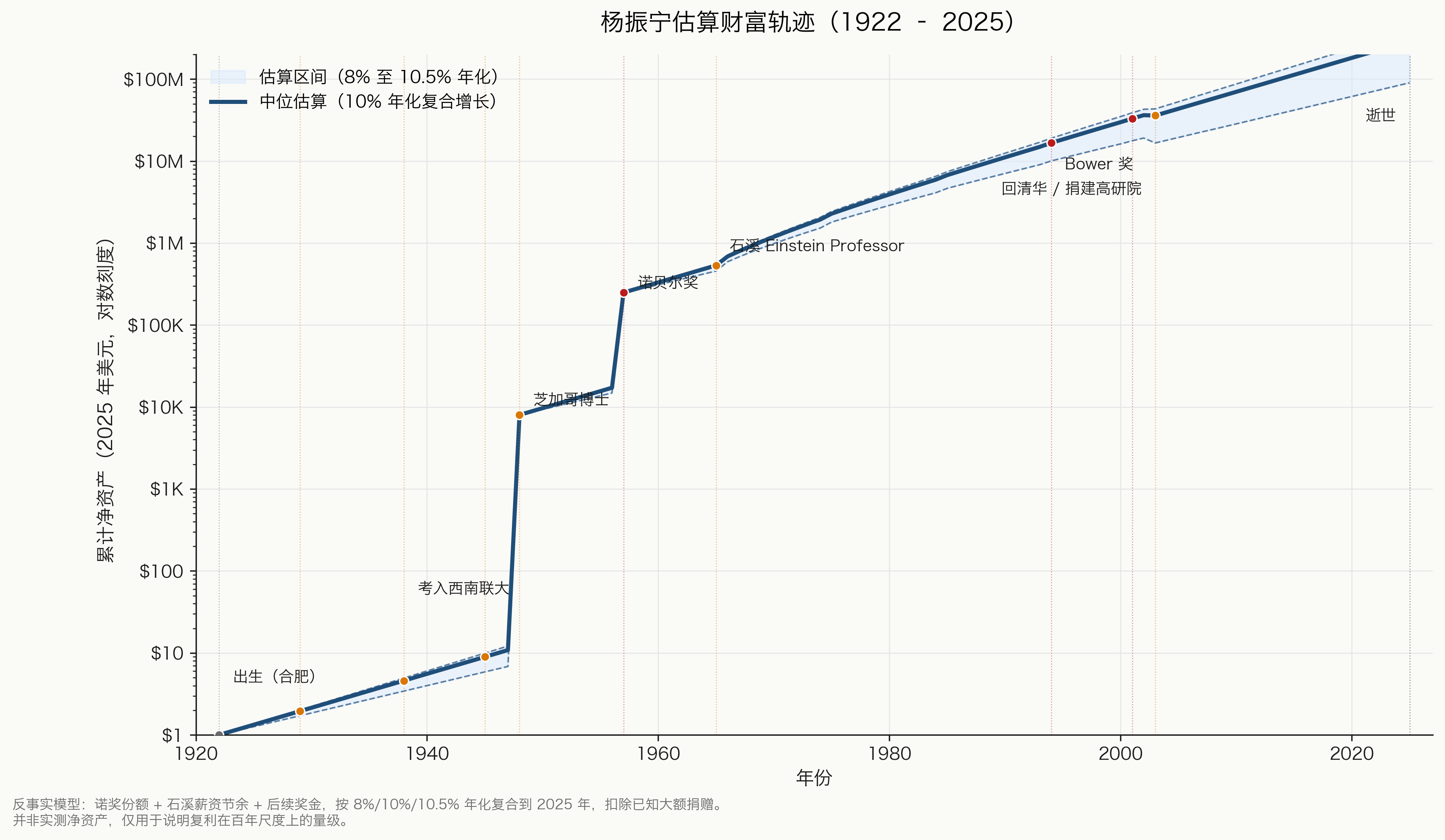 Figure 1: Yang Zhenning’s estimated wealth trajectory (1922–2025). Counterfactual model: Nobel share, Stony Brook salary savings, and subsequent prizes compounded at 8% / 10% / 10.5% annualized into 2025, with known major donations subtracted. Note the Y-axis is on a log scale. This is not measured net worth; it illustrates the order of magnitude that compounding produces over a 100-year scale.
What is most striking when you plot this trajectory on a log scale is not the endpoint, but the nearly vertical jump between 1948 (PhD) and 1957 (Nobel). In those nine years, his “effective capital” rose by about four orders of magnitude. In the 68 years that followed, even aggressive compounding could only add another two. What he accomplished in those 9 years from 1948 to 1957 mattered more than 68 years of subsequent compounding. That is one of the most counterintuitive, and most revealing, facts about the economics of scientific prestige.
And the 1957 Nobel share itself: how many different “equivalent-value” algorithms can you use to measure it?
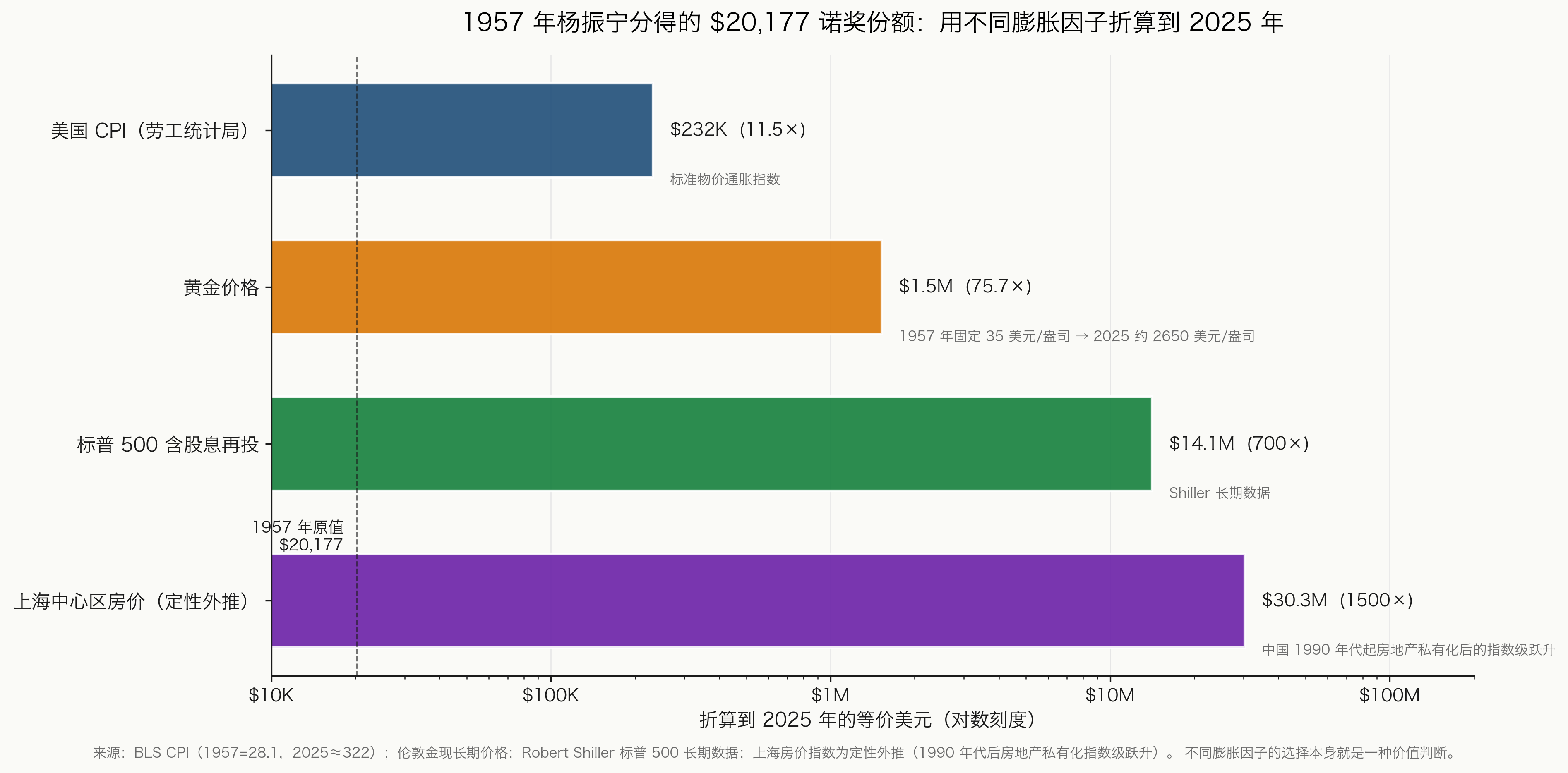 Figure 2: Yang’s 1957 Nobel share of $20,177 expressed in 2025 dollars under four different “deflators.” The same sum can become $230,000, $1.5M, $14M, or $30M, depending entirely on which yardstick you use. CPI measures “how many eggs at the supermarket,” the S&P 500 measures “what if you had indexed it in 1957,” gold measures “what a hedging store of purchasing power did,” Shanghai housing measures “what if the money had landed in first-tier Chinese real estate.” Every single deflator carries a value judgment behind it; none is “objectively correct.” This is exactly why any single inflation number is misleading.
Once we have unpacked the structure of this $10–50 million estimate, a deeper question naturally emerges. The source of this wealth, namely that brilliant academic career, how was it actually launched? To answer that, we need to turn the clock back a century, to where it all began: his family.
From scholar-gentry origins to Nobel Prize: how privilege compounds
Yang Zhenning’s family background placed him in the top 0.1% of Chinese society during the Republican era. His father Yang Wuzhi (1896–1973) was China’s first PhD in number theory, earning his doctorate at the University of Chicago in 1928 under L.E. Dickson. As a Tsinghua University professor, Yang Wuzhi earned 300–500 silver yuan monthly, comparable to a provincial governor’s pay, and roughly 60–100 times what a rural primary school teacher made. To put that ratio in context: in 1930s China, literacy was below 20%, the share of the population with any kind of middle-school education was under 1%, and the total number of returned-overseas PhDs holding faculty positions at Tsinghua, Peking University, or Yenching was probably a few hundred nationwide. Yang Wuzhi was not merely middle-class. He sat at the apex of China’s knowledge-elite pyramid.
The Yang family traced its lineage to scholar-gentry stock from Hefei. Yang Zhenning’s grandfather, Yang Bangsheng, was a xiucai-degree holder who worked as a tutor and clerk in Tianjin and Shanghai. Yang Wuzhi himself had to climb out of early hardship: orphaned at 12 when his father died of plague, raised with the help of his uncle Yang Bangrui, who supported him through middle school. In 1923 he won a state-funded scholarship from Anhui Province to study in the US, took a math degree at Stanford, then transferred to the University of Chicago, where in 1928 he received his PhD with the thesis Various Generalizations of Waring’s Problem, becoming the first Chinese doctorate in modern number theory. His academic success restored the family to the elite tier.
Back in China, after brief stints at Xiamen University and Tsinghua, Yang Wuzhi settled in the Tsinghua campus in 1929. The family lived in Tsinghua’s Western Court faculty housing, alongside historian Chen Yinke, essayist Zhu Ziqing, poet Wen Yiduo, philosopher Feng Youlan, physicist Ye Qisun, and other luminaries. Western Court was built to American-style suburban single-family standards: 14 rooms per unit, independent kitchen and bath, running water, electric lighting, telephone lines; some units even had refrigerators and Western tubs. In 1930s China, this was housing that fewer than 1 in 10,000 families experienced.
Young Zhenning enjoyed an extraordinary educational ecosystem:
- Early literacy: Could read more than 3,000 Chinese characters before age 5, working through Longwen Bianying, Three-Character Classic, and Youxue Qionglin in private school.
- Elite schools: Attended Chengzhi Primary (a Tsinghua school for faculty children) and then Chongde Middle School in Beijing, an Anglican boys’ school whose alumni included Deng Jiaxian and Lin Jiaqiao, other future world-class scientists.
- Private tutoring: His father hired Ding Zeliang, a star student of the historian Lei Haizong, specifically to tutor him in Mencius. The young Yang memorized the entire text, an experience he later said gave him a feel for the rhythm of classical Chinese that paid off six decades later when writing bilingual papers and lectures.
- Mathematical immersion: His father kept L.E. Dickson’s History of the Theory of Numbers and Modern Algebraic Theories on the study shelves; Dickson had been Yang Wuzhi’s PhD advisor and was a major figure in early-20th-century American number theory and group theory. The young Yang was leafing through these by middle school.
- Campus immersion: From age 7 to 16, he lived on the Tsinghua campus surrounded by China’s intellectual elite. He later recalled childhood Tsinghua as “a complete world,” with sports fields, libraries, auditoriums, enough peers, and enough quiet.
In 1937, war broke out and the family followed Tsinghua south, first to Changsha and then to Kunming. For a typical Chinese family this kind of displacement was catastrophic; for the Tsinghua professor families, salaries, housing arrangements, and school enrollments all moved together. The hardship was real, but the social position did not collapse. In 1938, age 15 and without having completed high school, Yang placed 2nd among 20,000 applicants to enter Southwest Associated University (the wartime merger of Tsinghua, Peking, and Nankai) on equivalent-qualification status. His father was teaching in the math department there, providing the priceless networking access to mentors such as physicist Wu Dayou, Wang Zhuxi, Zhang Wenyu, Zhao Zhongyao, and mathematicians Chen Xingshen (S.S. Chern) and Hua Luogeng. Wu Dayou supervised his undergraduate thesis, Wang Zhuxi supervised his master’s thesis, neither of these matches was accidental; they were the kind of thing a father within the same department arranges with a few words. This “networks-as-capital” logic is also the prelude to how he later won the Boxer Indemnity scholarship and made it to Chicago.
The Boxer Indemnity gateway: how family capital enabled American education
Yang’s path to the Chicago PhD program is the best illustration of how the family advantages from the previous section translate into concrete opportunities. In 1943 he won the prestigious Boxer Indemnity Scholarship (庚款留美公费生), the most competitive national fellowship of its era. The scholarship was funded from the residual portion of the Boxer Indemnity that the US Congress voted in 1908 to return to China, earmarked for sending Chinese students to study in America. For physics, the 1943 cohort had only 6 spots nationwide, and Yang was one of them. The package included:
- Flight from Sichuan to India via the Hump route: 15,000 silver yuan (a typical urban worker earned 30–50 silver yuan a month at the time)
- Steamship passage from Bombay to San Francisco: $875
- Monthly living and tuition allowance: $150 (a typical US worker at the time made about $200/month, so this was enough to support a graduate student)
- Equipment and book allowance, plus travel reimbursements
- A lump-sum settlement allowance on arrival in the US
In 1943 purchasing-power terms, the total scholarship was roughly equivalent to 8–10 years of a Chinese university lecturer’s salary. Whether or not you could secure a package of this scale essentially decided whether a STEM-talented Chinese youth would actually make it to the doorstep of a Chicago, Caltech, or Harvard lab.
His father’s academic network proved decisive. Yang Wuzhi’s own PhD advisor L.E. Dickson had written the group theory textbook Modern Algebraic Theories, and it was Yang Wuzhi who gave this book to his son. It directly shaped the younger Yang’s research arc into group theory, symmetry, and gauge fields. Yang’s undergraduate thesis Group Theory and Molecular Spectra (under Wu Dayou) and his master’s thesis Contributions to Statistical Mechanics (under Wang Zhuxi) both rested on the group theory books on his father’s shelves at home. When he applied to US graduate schools in 1945, his original plan was to study under E.P. Wigner (the founding figure of group-theoretic quantum mechanics) at Princeton, but Wigner was on leave that year, so he went to Chicago instead. It was a lucky accident, but accidents only land productively on people who have already been brought to the doorstep.
After arriving in Chicago in 1946, Yang worked under Enrico Fermi and Edward Teller. He had originally wanted to do experimental physics, even working in Allison’s lab, but his lack of practical lab dexterity became something of a joke in Chicago circles (“Where there is a bang, there is Yang”). He eventually shifted to theory, and Teller supervised his dissertation On the Angular Distribution in Nuclear Reactions and Coincidence Measurements, awarded in 1948. Yang earned his PhD at age 26, four to five years faster than peers, and that speed was a direct consequence of the full acceleration stack his father provided: pre-reading, pre-coursework, pre-selected mentors.
This acceleration applied not only to Yang Zhenning. The entire Yang sibling cohort racked up remarkable educational outcomes. Younger brother Yang Zhenping took a physics PhD at Johns Hopkins and became a physics professor at Ohio State, working in statistical and condensed matter physics. Sister Yang Zhenyu earned a neurobiology PhD at Stony Brook and returned to China to become a researcher at the Shanghai Institutes for Biological Sciences of the Chinese Academy of Sciences. Another brother, Yang Zhenhan, became an executive at Xinhua’s Hong Kong branch, working on cross-strait affairs through the Hong Kong handover years. This “STEM-heavy, US-China bridged, every sibling well-placed” structure is extremely rare for a Chinese intellectual family that survived 1949. Most families of comparable origin were broken up in successive political campaigns, or marginalized for their “American background.” That the Yang family preserved this continuity speaks to how carefully Yang Wuzhi managed family arrangements across generations.
Yang Zhenning’s own three children (with his first wife Du Zhili) all completed their education in the US and pursued professional careers: eldest son Yang Guangnuo is a computer scientist who worked at IBM; second son Yang Guangyu is a chemist; daughter Yang Youli is a physician. This cross-generational pattern of elite educational outcomes is typical of Nobel laureate families and reflects accumulated cultural, social, and financial capital. These three forms of capital are mutually convertible, and each generation autonomously selects marriages, schools, and careers that protect and extend them.
The science of privilege: Nobel laureates emerge from the elite
Yang Zhenning’s biography to this point gives a qualitative answer: family background deeply shaped his scientific trajectory. But that is only one case. To know whether this pattern is systematic, we need data. Recent research quantifies what Yang’s biography illustrates qualitatively. A landmark 2024 study by Novosad, Asher, Farquharson, and Iljazi analyzed 739 Nobel laureates across physics, chemistry, medicine, and economics from 1901 to 2023, systematically comparing their family backgrounds to contemporaneous national populations. The findings reveal profound socioeconomic stratification:
- The average laureate grew up in the 87th income percentile and 90th education percentile
- 50–60% of laureates came from families in the top 5% of households
- Female laureates came from even more elite backgrounds (91st percentile vs. 87th for men). Counterintuitive, but consistent with the interpretation that the structural barriers facing women in science are so steep that those who break through tend to be the women who can simultaneously deploy class privilege to offset gender disadvantage.
- Six laureates had fathers who were also Nobel laureates: Niels Bohr & Aage Bohr, J.J. Thomson & G.P. Thomson, William Bragg & Lawrence Bragg, Manne Siegbahn & Kai Siegbahn, Arthur Kornberg & Roger Kornberg, Hans von Euler-Chelpin & Ulf von Euler.
- At current rates of progress, it would take about 600 years before Nobel winners’ backgrounds match the general population.
- Different disciplines have different “thresholds”: economics laureates have the most elite family backgrounds, physics and medicine come next, chemistry is slightly less so. This aligns with the family resources each discipline’s training pipeline requires (middle-school math foundations, graduate program length, postdoc financial endurance).
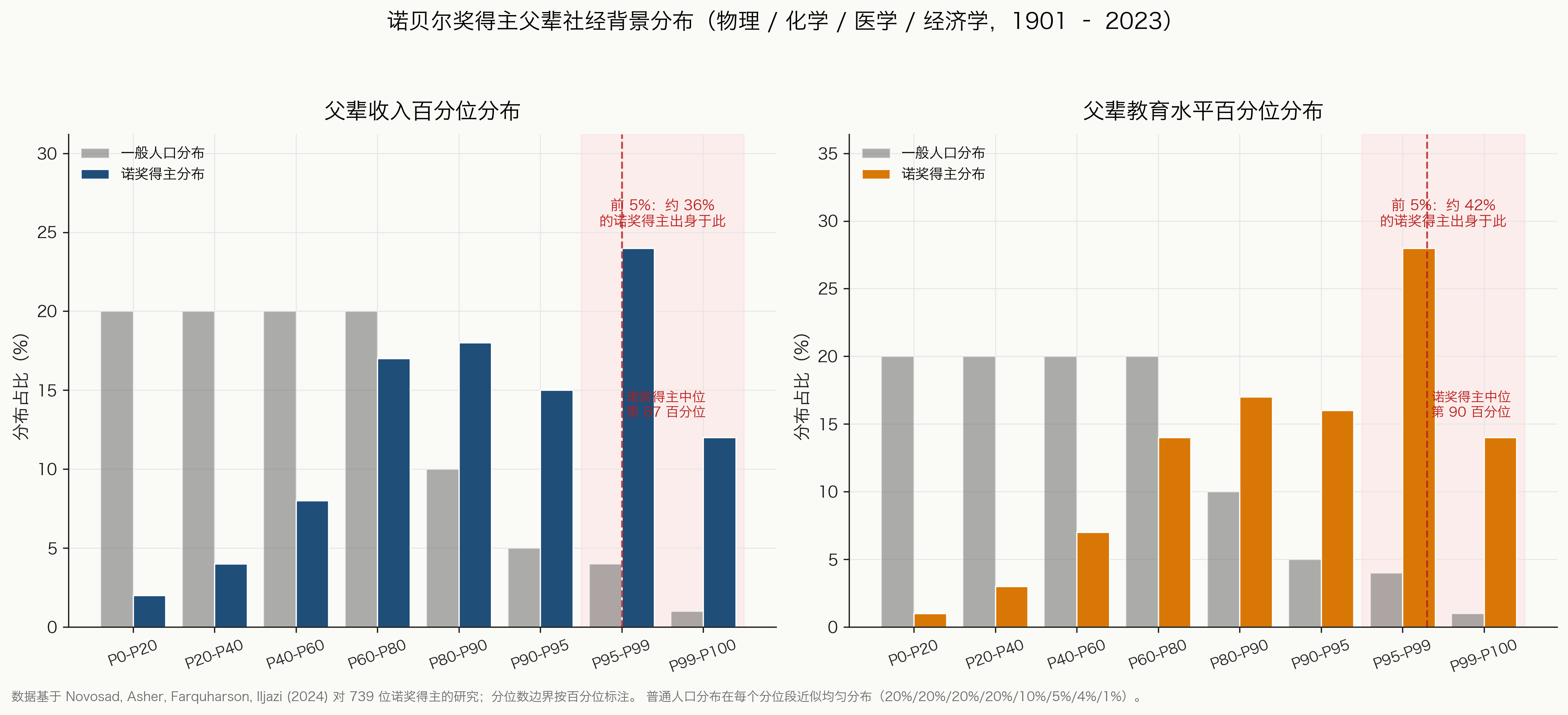 Figure 3: Parental socioeconomic background distribution of Nobel laureates. Left panel is income percentile, right panel is education percentile. Gray bars are “what each percentile bucket would contain if there were no socioeconomic bias,” blue/orange bars are the actual laureate distribution. The red shaded region (top 5%) makes the “50–60% of laureates come from top-5% families” statement viscerally obvious.
A complementary 2022 study in Nature Human Behaviour by Morgan, Clauset, and colleagues surveyed 7,204 US tenure-track faculty across disciplines and institutional tiers. They found faculty are up to 25 times more likely than the general population to have a parent with a PhD, and this ratio nearly doubles at top-tier universities, meaning the more elite the school, the stronger the intergenerational reproduction of academic careers. This pattern has remained stable for 50 years, with no improvement. The “openness” policies of the 1970s, the diversity initiatives of the 1990s, the DEI reforms of the 2010s have barely shifted academic selection. Morgan et al. even found that in subfields like theoretical physics, pure mathematics, and economics, the “share of faculty who are children of PhDs” has actually risen slightly over the past 30 years.
Raj Chetty et al.’s 2019 Quarterly Journal of Economics paper, “Who Becomes an Inventor in America?” (the “Lost Einsteins” paper), is the most policy-influential study in this line. They tracked 1.2 million US inventors (identified through patent filings), linked the patent data to 1996–2014 IRS tax records, and merged in third-grade math test scores from the Project STAR experiment. Key findings:
- Children from top-1% families are 10× more likely to become inventors than children from below-median income families.
- The gap persists after controlling for third-grade math test scores, meaning that even among children with identical early math ability, wealthier-family children still become inventors at substantially higher rates.
- Gender and race gaps are equally large: white men become inventors at over 5× the rate of Black men and 4× the rate of women.
- Counterfactual: if women, minorities, and low-income children became inventors at the same rate as high-income white men, the US would have four times as many inventors.
- The key mediator is not genes or innate talent, but how childhood environments shape the “I could be an inventor” identity: growing up in inventor-dense neighborhoods, having inventor parents or neighbors, seeing same-gender same-race inventor role models are the strongest predictors.
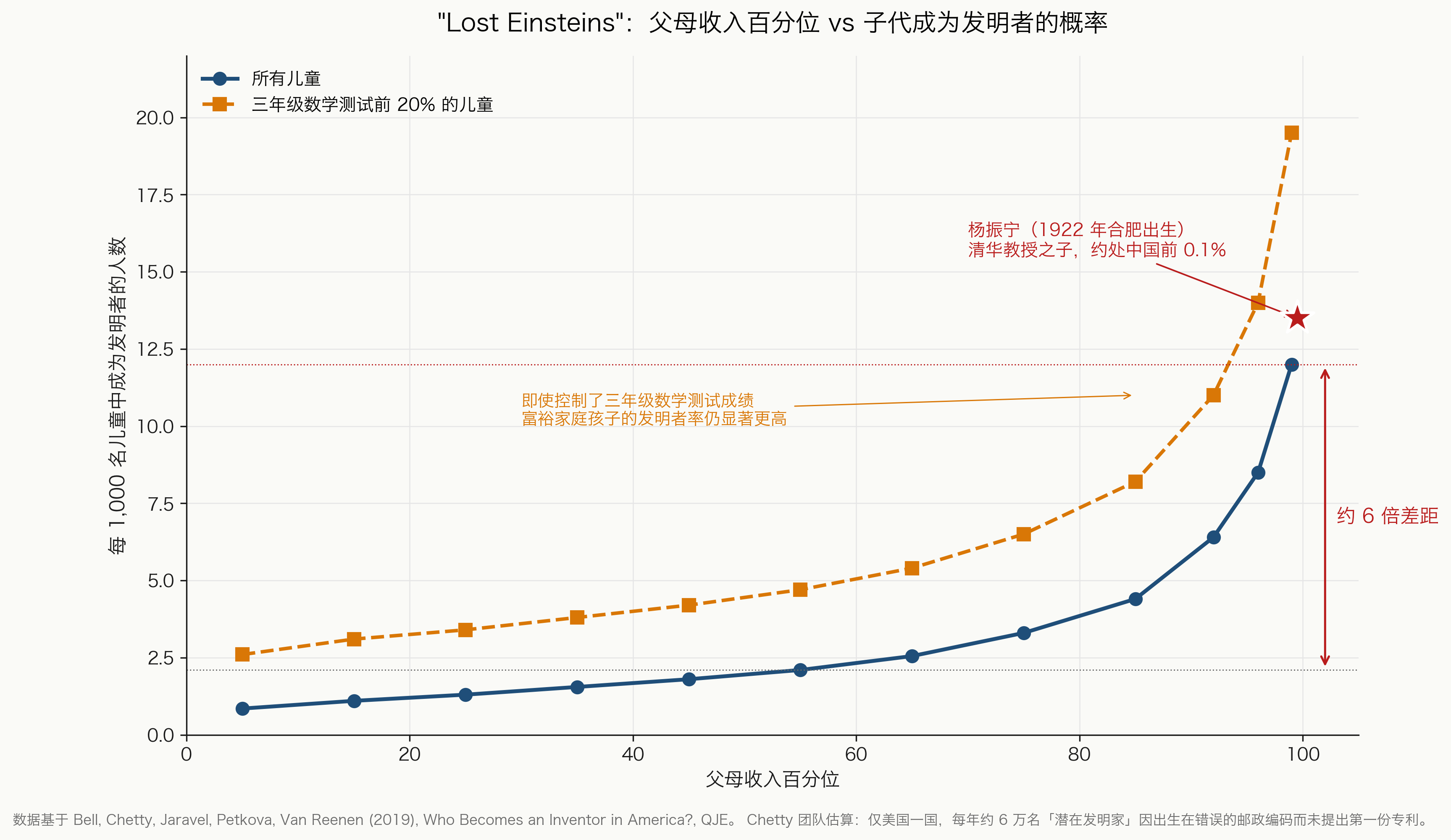 Figure 4: A reproduction of the core figure from Chetty et al.’s 2019 QJE paper “Who Becomes an Inventor in America?”. The blue line is the inventor rate per 1000 children by parental income percentile; the orange dashed line is the same indicator restricted to children in the top 20% of third-grade math scores. Both curves shoot nearly vertical at the high end, and there is a 6–10× gap in inventor rates between wealthy and median families, persisting after controlling for early math ability. The red star marks Yang Zhenning: born in Hefei in 1922, he was roughly in the top 0.1% of the Chinese income distribution at the time. This figure tells the same story as Figure 3 from a different angle.
Pushing Chetty’s findings forward: viewed through this lens, Yang Zhenning’s childhood environment was practically the upper bound of “inventor density.” Almost every other house in the Tsinghua compound held a US-returned PhD or an academy candidate. His peers were professors’ children, his neighbors were leading scholars in adjacent fields. This environment provides not just educational resources but a defaulting of “becoming a scientist” as a life path. For a child growing up in the Tsinghua compound, going to the US for a PhD was not an aspirational luxury, it was as natural a next step as “going to college.” But socioeconomic background is only half the story. The other half is who is standing at the door waiting to bring you inside. That is the role of academic mentorship networks.
Academic genealogy: the Nobel family tree
Richard Tol’s 2024 Scientometrics study traced academic mentorship networks (using each scientist’s PhD advisor as the parent node in a directed graph) and discovered that 696 of 727 Nobel laureates (96%) belong to one single academic family tree, with 668 of them traceable back to Emmanuel Stupanus (1587–1664), a medical professor at the University of Basel. This tree covers nearly all natural-science Nobel lineages across physics, chemistry, medicine, and economics, and converges through key “hub” mentors across centuries: Friedrich Hoffmann in the 18th, Justus von Liebig in the 19th, Arnold Sommerfeld, Niels Bohr, and Enrico Fermi in the 20th, each of whom directly or indirectly trained multiple future laureates.
This remarkable concentration reflects how mentorship at critical career stages, terminal degree training and early independent research, shapes scientific potential. Tol’s study also found:
- Chemistry laureates have the most Nobel ancestors and descendants on this tree, making chemistry the “hub discipline” connecting laureates across fields.
- Economics laureates sit at the most peripheral positions on the network but have high internal clustering, reflecting that economics, as a relatively recent Nobel category, has lineages concentrated in the Chicago school, Harvard, and MIT.
- Physics laureates have the most “vertical” mentorship structure: from Sommerfeld to Heisenberg to Bethe to Schwinger, and downward through generation after generation of postdocs, an almost unbroken chain.
- The “mentor effect” is statistically independent of family background, meaning that a scientist who has both a famous-school PhD advisor and an educated family background sees their winning probability compound multiplicatively, not additively.
This pattern fits Yang Zhenning’s biography almost textbook-perfectly:
- His Southwest Associated University undergraduate advisor Wu Dayou was a Michigan PhD, a Chinese Physical Society colleague of his father’s.
- His master’s advisor Wang Zhuxi was a Cambridge PhD in statistical physics, his father’s neighbor in the Tsinghua math department.
- His Chicago PhD advisor Edward Teller came out of the Budapest school and is an indirect academic descendant of Werner Heisenberg and Arnold Sommerfeld.
- His key Chicago patron Enrico Fermi, 1938 physics Nobelist, was one of the 20th century’s most important “mentor hubs,” training more than 6 future Nobel laureates.
- His Southwest Associated University math mentor Chen Xingshen (S.S. Chern) had been Yang Wuzhi’s own student at Tsinghua in the 1920s, meaning Yang Zhenning’s mathematical training was effectively his father’s student teaching his father’s son.
Yang himself went on to supervise many notable physicists, including Bill Sutherland, the collaborators around Edward Lieb, and Shoucheng Zhang (whose formal advisor was Steven Kivelson rather than Yang, but who long acknowledged Yang as a key influence). The lineage continues. From this genealogical perspective, Yang is not simply “well-born.” He sits at one of the most valuable junction nodes in the 20th-century physics family tree, where the Dickson → Yang Wuzhi → Yang Zhenning number-theory-and-group-theory branch first meets the Sommerfeld → Fermi → Yang quantum-physics branch.
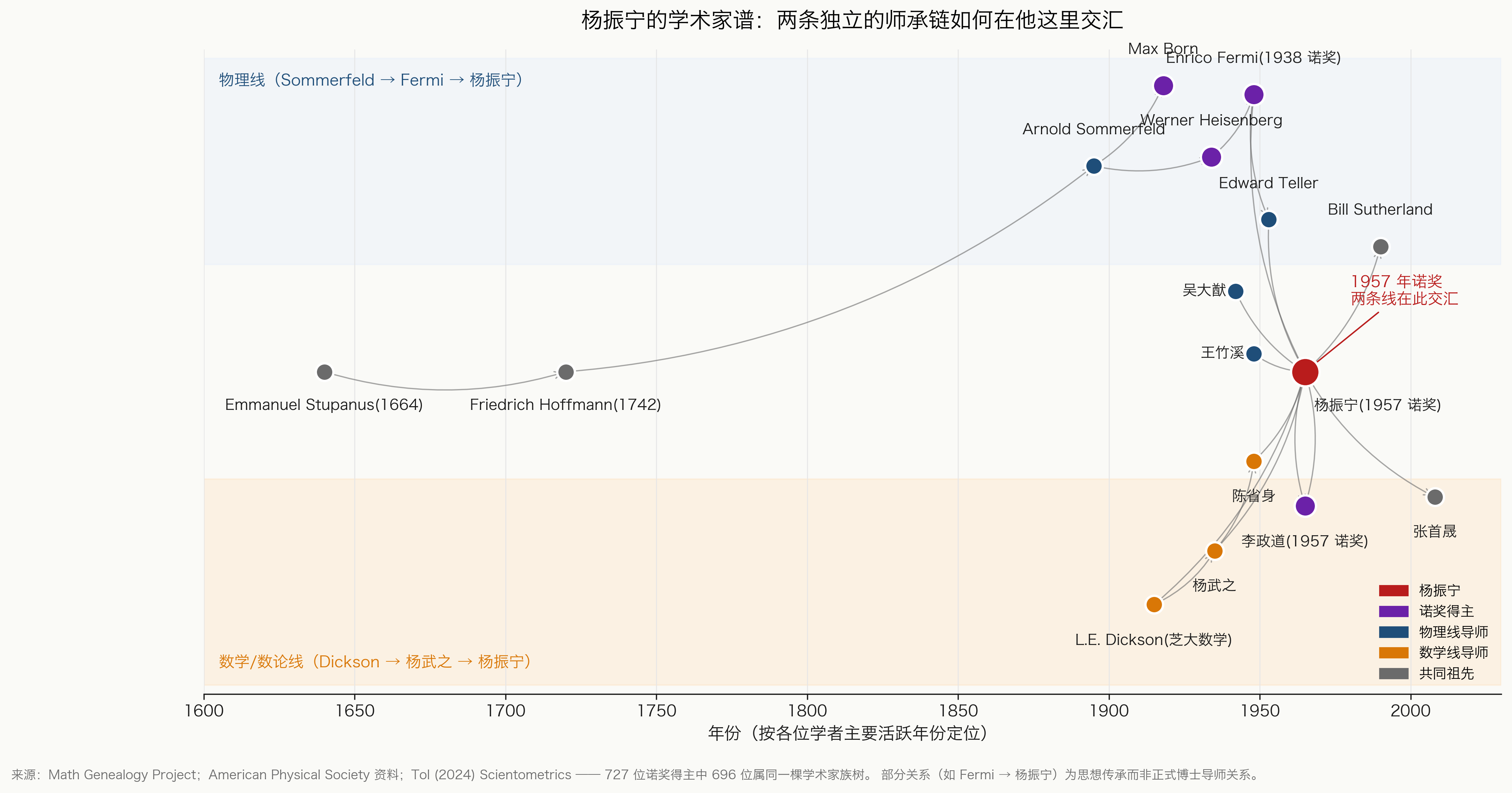 Figure 5: Simplified academic genealogy of Yang Zhenning. The upper blue-shaded region is the physics lineage: Sommerfeld → Born / Heisenberg → Fermi → Teller → Yang. The lower orange-shaded region is the math lineage: Dickson → Yang Wuzhi → Yang, with Chen Xingshen (a former student of Yang Wuzhi) also serving as one of Yang’s mentors at Southwest Associated University. Red large dot is Yang himself, purple dots are Nobel laureates. The “two independent elite mentorship chains converging in one person” structure is exceptionally rare in scientific history, and it explains why “his father was China’s first number-theory PhD” and “his advisor was Fermi” are really two sides of the same story.
But the family tree only explains “who gets to stand at the door.” It does not explain “how much wealth that person ends up with.” That brings us to the next question: can scientists actually become wealthy?
Can scientists really get rich? The prize-money paradox
Nobel Prizes bring prestige, but rarely bring wealth. The 2025 prize totals 11 million SEK (~$1.035 million), typically split among up to three laureates, leaving each one with roughly $350,000, of which Swedish withholding tax and home-country income tax may take half. Yale historian Bruno Strasser has said in multiple interviews: “Most recipients do not become wealthier after getting the Nobel Prize.” They are already established professors, many donate the money, and taxes eat a significant chunk.
Concrete examples abound:
- Einstein gave his entire 1921 Nobel prize money (121,572 SEK, ~$32,000 then) to his ex-wife Mileva Marić, per their 1919 divorce settlement, to support their two sons.
- Marie Curie won twice (1903 physics, 1911 chemistry) but spent most of the money on radium for further experiments and lab equipment.
- Paul Dirac, when he won in 1933, had a sufficient Cambridge lecturer salary, so he used most of his prize money to support his retired father and to help refugee physicists escape Nazi Germany.
- Yang and Lee split the 1957 prize, each taking home about $20,000. With US postdoc salaries at $5,000–8,000, that was 3–4 years’ worth of pay, substantial but not life-changing wealth.
- Tu Youyou (2015) donated most of her prize money to establishing innovation funds at Peking University and the China Academy of Chinese Medical Sciences.
What the Nobel actually brings is not money but bargaining power. Post-prize, you get visiting professor positions, board seats, government advisory roles, corporate consulting contracts, and each of these can generate cash flow an order of magnitude larger than the prize itself. That is why “Nobel laureate net worth in the tens of millions” is statistically not rare. It is not the prize. It is the downstream income the prize unlocks. But that downstream income has a ceiling, and the ceiling sits at a sharp discontinuity between academia and industry.
The real wealth gap is between academic and industry scientists. Nature’s 2021 salary survey (3,200+ researchers globally) found that industry researchers earn 40–60% more than academic counterparts, with tech and AI positions reaching $400,000+. Specifically:
- Academic postdocs make $37,000–$50,000 (the US NIH 2024 starting stipend is $61,008, but many institutions still pay below $50,000)
- Academic assistant professors: $70,000–$120,000
- Academic associate professors: $90,000–$160,000
- Academic full professors: $130,000–$250,000
- Endowed chairs at top universities: $175,000–$306,000 (Stanford 2024 median full-professor pay is $306,288; Harvard, MIT, Princeton are in the same band)
- Industry PhD-level scientists at large pharma (Merck, Pfizer, Genentech etc.): $130,000–$228,000
- Senior AI/ML research scientists at top tech firms (Google DeepMind, Meta FAIR, Anthropic, OpenAI): total comp (base + RSU + bonus) of $400,000 to $1,000,000+
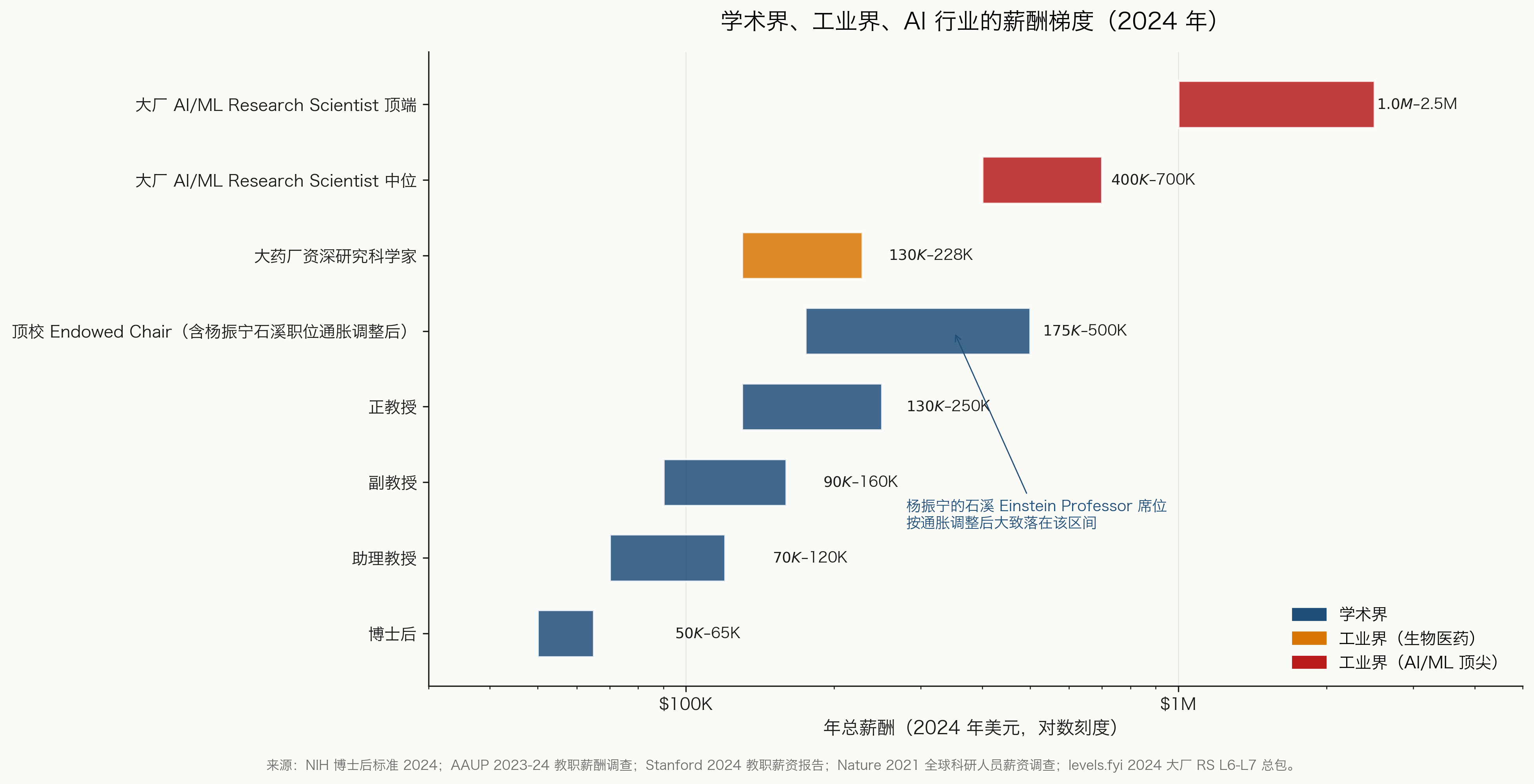 Figure 2 (here, Figure 6): 2024 compensation gradient across academia, industry, and the AI sector (log scale). From a postdoc to a senior AI research scientist at a top firm spans more than 40×. Note the X-axis is logarithmic: on a linear scale, the first six bars would be squashed together and the last would fly off the chart. A top-university full professor’s ceiling is roughly the floor of a senior AI research scientist’s package. For a physicist of Yang’s generation who walked the full academic ladder, the endpoint is the “top-school Endowed Chair” tier in this figure, inflation-adjusted to roughly $175,000–$500,000, well below what a mid-tier AI engineer makes at a frontier lab. This is exactly why the post says “what the Nobel actually brings is bargaining power, not money.”
Putting this gradient into Yang’s era: when he jumped from Princeton IAS to Stony Brook in 1965 as the Albert Einstein Professor, the salary on the table was at the top of the SUNY pay scale, inflation-adjusted to roughly $350,000–$500,000 in today’s terms. Stony Brook gave him not just a salary but a dedicated research assistant, a personal secretary, a reduced teaching load (one graduate course per year), and an unlimited academic travel budget. This was effectively the university funding a “miniature research institute” around a flagship scholar out of the campus budget.
Toda and Sun’s 2019 Econ Journal Watch study analyzed compensation data for 1,500+ US economics professors. The financial return inside academia is surprisingly rigid: there is a Matthew effect not just for citations, but for budgets. Once a reputation is built, the marginal cost of getting more research funding drops sharply, and the access compounds like interest over a career. But that “budget compounding” mostly stays on the institutional balance sheet, paying for better equipment and more postdocs, and rarely flows into the scientist’s personal account. The same paper also found:
- Publishing in one of the economics top-5 journals (QJE, AER, JPE, Econometrica, REStud) raises a professor’s salary by only 2.8%.
- Citation count starts to move salary only above about 400 citations; below that threshold, citations barely matter.
- “Which school you teach at” predicts salary about 5× better than “how many top-journal papers you have published.”
- Moving to a higher-ranked school produces a salary jump 3× larger than publishing 10 top-journal papers.
Within academia, the correlation between scientific output and income is weak. The real financial returns come from entrepreneurship. NBER research (Zucker, Darby, and others, starting from the 1990s) shows “star scientists” play central roles in successful commercialization, and successful scientist-founders in biotech achieve wealth far beyond academic salaries. Typical examples include Robert Langer (MIT chemical engineering professor, co-founder of 40+ companies, estimated net worth over $1 billion), Carl June (one of the inventors of CAR-T cell therapy, earned tens of millions through Novartis partnerships and equity stakes), George Church (Harvard geneticist, co-founder of more than a dozen biotech companies). These figures represent a new generation of “high prestige + venture-capital fluency + commercialization capability” scientists, whose wealth accumulation paths are completely unlike the “pure academia + single employer” path Yang walked.
Compared to these contemporary academic stars who move smoothly between the bench and the boardroom, Yang’s wealth number looks classical, even understated. He did not build a commercial empire by spinning off his theoretical physics breakthroughs. His wealth trajectory remained firmly anchored in the traditional academic ivory tower: a top salary, plus most of a century of capital-market compounding. Stripping away the contemporary filter makes it easier to see the underlying logic that powered 20th-century science.
Conclusion: talent, privilege, and the reproduction of scientific elites
Yang Zhenning’s life trajectory, from a Tsinghua-campus childhood to Nobel laureate to an estimated $10–50 million net worth, vividly illustrates the systematic advantages that enable scientific greatness. His father’s status as China’s first number-theory PhD, his childhood immersion in intellectual-elite circles, his access to the Boxer Indemnity Scholarship, his academic genealogy connecting through Chicago and Fermi, all reflect documented patterns: Nobel laureates overwhelmingly emerge from upper socioeconomic strata, faculty reproduce their class backgrounds across generations, and identical early talent produces vastly different outcomes depending on family resources.
Acknowledging structural advantage does not diminish his personal intellectual contribution. The Yang–Mills gauge theory he proposed with Robert Mills in 1954 is one of the most important theories of late-20th-century physics, the mathematical foundation of the Standard Model; his work with T.D. Lee on parity non-conservation directly produced the 1957 Nobel. The intellectual weight of these contributions is real and irreplaceable. But understanding a person’s achievements requires holding two things together at once: their ability, and the conditions under which their ability could be expressed. The two are not mutually exclusive. In Yang’s case the coupling is exceptionally tight: without the Tsinghua-compound childhood, without the mentorship network Yang Wuzhi arranged in advance, without the Boxer Indemnity scholarship, without Fermi’s tutelage, he might still have been a great physicist, but whether he would have completed Yang–Mills by age 35 and won the Nobel by age 35 is a counterfactual that cannot be answered.
The evidence suggests scientific talent is far more common than scientific achievement, and the gap is filled by privilege. As “Lost Einsteins” demonstrates, many potential Yangs never reached their potential because they lacked the family wealth, networks, and cultural capital that compound across generations. Chetty’s team estimates that in the US alone, about 60,000 “potential inventors” each year never file a first patent because they were born in the wrong zip code. Extrapolated across the world and across the full 20th century, the total mass of “potential Yangs” lost to structural conditions is staggering.
In the second half of his life, Yang himself recognized this debt to circumstance and tried to act on it: donating millions of dollars to Tsinghua, never collecting his Chinese salary, personally teaching undergraduates (he repeatedly taught freshman general physics at Tsinghua, a fact much celebrated in Chinese academia), leading the establishment of the Tsinghua Institute for Advanced Study, and recruiting back a generation of top ethnic-Chinese physicists (Andrew Yao, Nie Huatong, Weng Zhengyu, and others), trying to replicate the “mentorship + resources + network” advantage stack he had enjoyed for the next generation of Chinese scholars.
But individual philanthropy ultimately cannot shake the structure itself. The structural patterns identified in recent science-of-science research show that such individual philanthropy, however admirable, has barely moved the needle on scientific access in more than a century. Morgan et al.’s data say it plainly: 50 years and no improvement. Philanthropy can change the fates of 100 or 1000 students, but not the structure itself. The structure has to be moved by larger levers: public policy, scholarship systems, the universality of childcare and basic education, “inventor density” in neighborhoods.
So Yang’s story comes back to the question list at the top of this essay. When we ask how much money he had, what we are really asking is whether the wealth, prestige, and influence of a person born in that particular 20th-century window, that particular family, and that particular country, are the reward of individual effort, the byproduct of structural conditions, or an entangled state that cannot be cleanly separated. Whether the number is $10 million or $50 million or $250 million matters less than the structure behind the number, and the question of what we would have to change if we actually wanted more people like Yang Zhenning.
That is also why I wrote this long post. The greatness of an idol is not that they are some unworldly saint, but that within complex worldly structures and historical gaps, they make irreplaceable intellectual contributions. Whatever happens to the dollar figure, that purity of “as proud of my Chinese heritage… as I am devoted to modern science” is the heaviest legacy Professor Yang has left to Chinese science.
Key sources and papers
Yang Zhenning Net Worth and Biography:
- Nobel Prize biography: https://www.nobelprize.org/prizes/physics/1957/yang/biographical/
- Stony Brook tribute: https://news.stonybrook.edu/university/c-n-yang-nobel-prize-winning-physicist-defined-stony-brooks-scientific-excellence/
- Chinese Wikipedia (杨振宁): https://zh.wikipedia.org/zh-hans/杨振宁
Yang Family Background:
- Yang Wuzhi biography (Chinese): https://zh.wikipedia.org/zh-hans/杨武之
- Baidu Baike (杨武之): https://baike.baidu.com/item/杨武之/4544341
- Republican-era professor salaries: https://www.jiemian.com/article/2253209.html
Science of Science Academic Papers:
- Novosad et al. (2024), “Access to Opportunity in the Sciences: Evidence from Nobel Laureates”: https://paulnovosad.com/pdf/nobel-prizes.pdf
- Morgan et al. (2022), “Socioeconomic Roots of Academic Faculty,” Nature Human Behaviour 6:1625-1633: https://www.nature.com/articles/s41562-022-01425-4
- Bell, Chetty et al. (2019), “Who Becomes an Inventor in America?” Quarterly Journal of Economics 134(2):647-713: https://academic.oup.com/qje/article/134/2/647/5218522
- Clauset et al. (2015), “Systematic Inequality in Faculty Hiring Networks,” Science Advances 1:e1400005: https://www.science.org/doi/10.1126/sciadv.1400005
- Wapman et al. (2022), “Quantifying Hierarchy in US Faculty Hiring,” Nature 610:120-127: https://www.nature.com/articles/s41586-022-05222-x
- Tol (2024), “The Nobel Family,” Scientometrics 129:1329-1346: https://link.springer.com/article/10.1007/s11192-024-04936-1
- Wang & Barabási (2021), The Science of Science, Cambridge University Press: https://www.dashunwang.com/book/the-science-of-science
Scientific Careers and Wealth:
- Nature salary survey (2021): https://www.nature.com/articles/d41586-021-03567-3
- Toda & Sun (2019), “Publications, Citations, Position, and Compensation”: https://econjwatch.org/articles/publications-citations-position-and-compensation-of-economics-professors
- Azoulay et al. (2020), “Age and High-Growth Entrepreneurship,” AER: Insights: https://www.nber.org/papers/w24489
- Zucker & Darby, “Star Scientists and Biotechnology,” NBER: https://www.nber.org/reporter/fall-1998/entrepreneurs-star-scientists-and-biotechnology