
YC’s “Five Traitors”: When Rebels Meet Rebels, YC’s Breakup with the Founders Most Like Itself
Published:
Five YC rebels: some were expelled, some were welcomed back. What happened next?
Author: Koutian Wu; GitHub: ktwu01
Introduction
Y Combinator (YC) is Silicon Valley’s most prestigious startup accelerator, founded by Paul Graham and several partners in 2005. In his essay What We Look for in Founders, Paul Graham praised the naughty trait in founders: the spirit of having a piratical gleam in their eyes and delighting in breaking unnecessary rules. He wrote:
“They’re not Goody Two-Shoes type good. Morally, they care about getting the big questions right, but not about observing proprieties… They delight in breaking rules, but not rules that matter.”
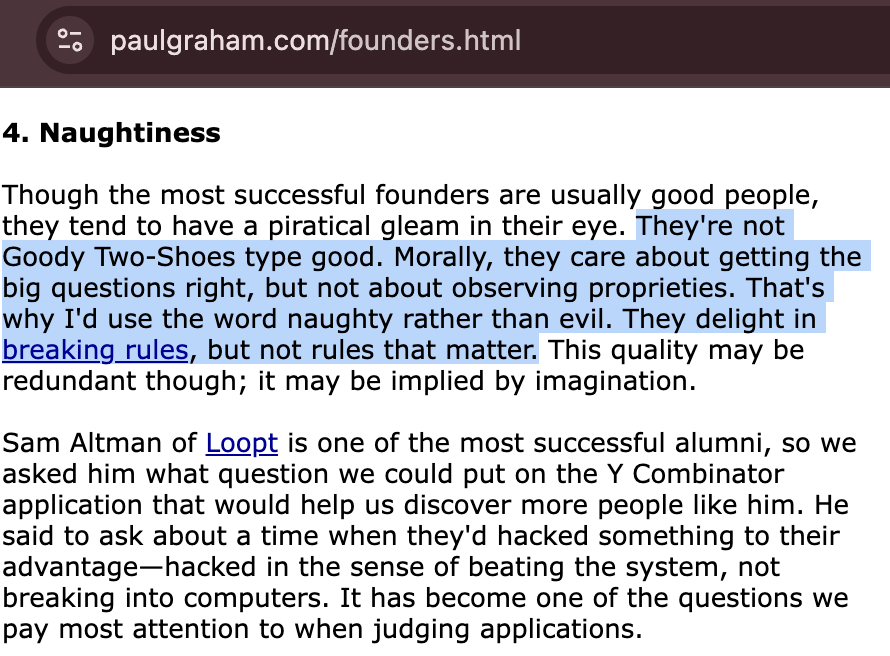
Paul Graham believes that the best founders often have a rebellious streak: they like to challenge the status quo, question authority, and even possess a slightly dangerous quality. YC’s selection mechanism is, in essence, looking for this kind of controlled madness.
But there is an interesting paradox here: the traits YC values most—independent thinking, challenging authority, and radical transparency—may touch the organization’s boundaries once they are directed at YC itself.
The experiences of Breck Yunits, Paul Biggar, Katia Damer, Andrew Torba, and Parker Conrad illustrate several different boundaries: confidentiality, public criticism, regulatory violations, harassment, and institutional loyalty. Conrad’s story is one of a comeback and institutional rehabilitation after a crisis, while Torba’s story defines the limits of the theory that “YC punishes rebels.”
To understand the seriousness of being kicked out, one must first understand the realm from which one is exiled. Y Combinator is not merely a source of funding; it is also a platform for gaining social recognition and operational leverage. The three pillars of this platform include Bookface, Hacker News, and the alumni directory.
The Three Pillars of the YC Network
Bookface: The Digital Homeland
At the heart of the YC experience is Bookface. Technically, it is a proprietary internal software platform combining a forum, a wiki, and a LinkedIn-like directory. Culturally, it is the public square of the YC community.
Bookface access lasts for life, which is equivalent to giving YC founders a digital green card. It creates a protective barrier for YC founders, allowing them to solve problems faster than their non-YC peers. Revoking Bookface access is the main administrative measure taken against removed founders; it is equivalent to stripping a citizen of their passport in the digital age. You are still there, but your identity is gone.
Hacker News: The Public Platform
Bookface is private, while Hacker News (HN) is public. However, HN is owned and operated by YC, and its content moderation is also handled by YC employees (one of the most famous users, dang, is Dan Gackle). Although HN appears to be an open link aggregator for computer science and startups, critics, including the removed founder Yunits, believe that it is actually a subtle tool for narrative control.
Hacker News’s algorithm determines what tens of thousands of technologists see every day. Removing a post (taking it off the front page) or flagging it can cause a story to lose visibility. For YC founders, HN is a crucial launchpad. Yunits, meanwhile, claims that for YC dissenters, HN often becomes a hostile environment where their criticism is buried or dismissed as noise and ignored.
The Alumni Network: Social Capital
YC alumni status is a powerful group marker. Some founders who were removed from the community say that when they are labeled unwelcome, this network effect reverses: instead of opening doors, their names may prompt private warnings, removal from private WhatsApp groups, a cold reception at Demo Day, and avoidance by former alumni worried about being implicated. These soft bans are often more damaging than the technical revocation of login credentials.
The Five “YC Traitors”
1. Breck Yunits: The Expelled Whistleblower
Yunits is a classic hacker: obsessed with truth, data visualization, and better systems (Scrolling/Tree Notation). That unconstrained geek spirit fits YC’s picture of a founder. But someone who keeps looking for ways to improve a system is unlikely to agree that YC’s own rules should be exempt from scrutiny.
By December 2022, he was already talking publicly about being banned from Bookface. Being kicked out did not end his criticism of YC.
In September 2024, he turned his questions to how YC shares its profits. His Carry proposal argued that founders in the same batch should demand a share of YC’s carry, the fund manager’s cut of investment profits. His reasoning was direct: founders create long-term value for YC, so why shouldn’t they share in the fund’s returns?
His dissatisfaction with Hacker News was even more direct. In the same Reddit discussion, Yunits (posting as breck) accused the platform of manipulating post visibility and suppressing criticism of YC. He even renamed Bookface “Dickface”:
“I couldn’t give two shits about being kicked out of Dickface. It’s the constant censorship on HackerNews and their other daily censorship that pisses me off. I’m not asking them to upvote my stuff, I’m asking them to let my stuff be downvoted. The fact that they are so afraid of people reading what I have to write that shows what scared little cowards they are.” — Breck Yunits on Reddit
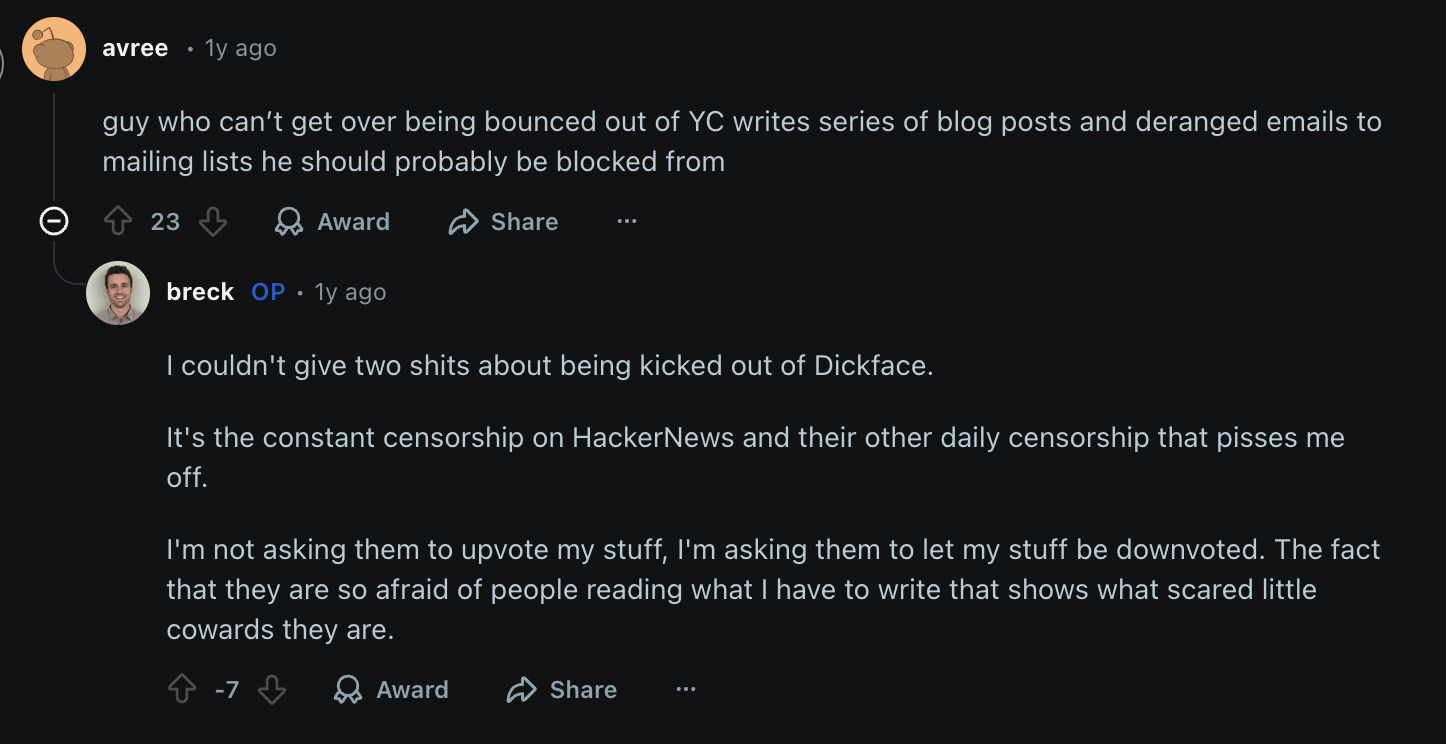
He was willing to be downvoted by readers; what he was fighting for was for readers to see his work in the first place. A platform that presents itself as open should let readers judge criticism of it for themselves.
Yunits also said in that discussion that the official @ycombinator Twitter account had blocked him and that he could no longer email @ycombinator.com addresses. Removed from the private community, he kept questioning how much power it exercised over public discussion.
YC praises founders who challenge the rules. Yunits includes YC’s rules. That rebellious streak is attractive when you are recruiting founders; it can be harder to live with afterward.
2. Paul Biggar: Willing to Offend His Own Circle
Biggar is a co-founder of CircleCI and now the founder and CEO of Tech for Palestine. Taken together, the vaccine-queue dispute and his later advocacy for Palestine reveal a consistent trait: when something is wrong, neither how well he knows the people responsible nor how much they have helped him is a reason to stay quiet.
YC encourages founders to be honest and direct and use less PR language. But candor can also embarrass their own circle.
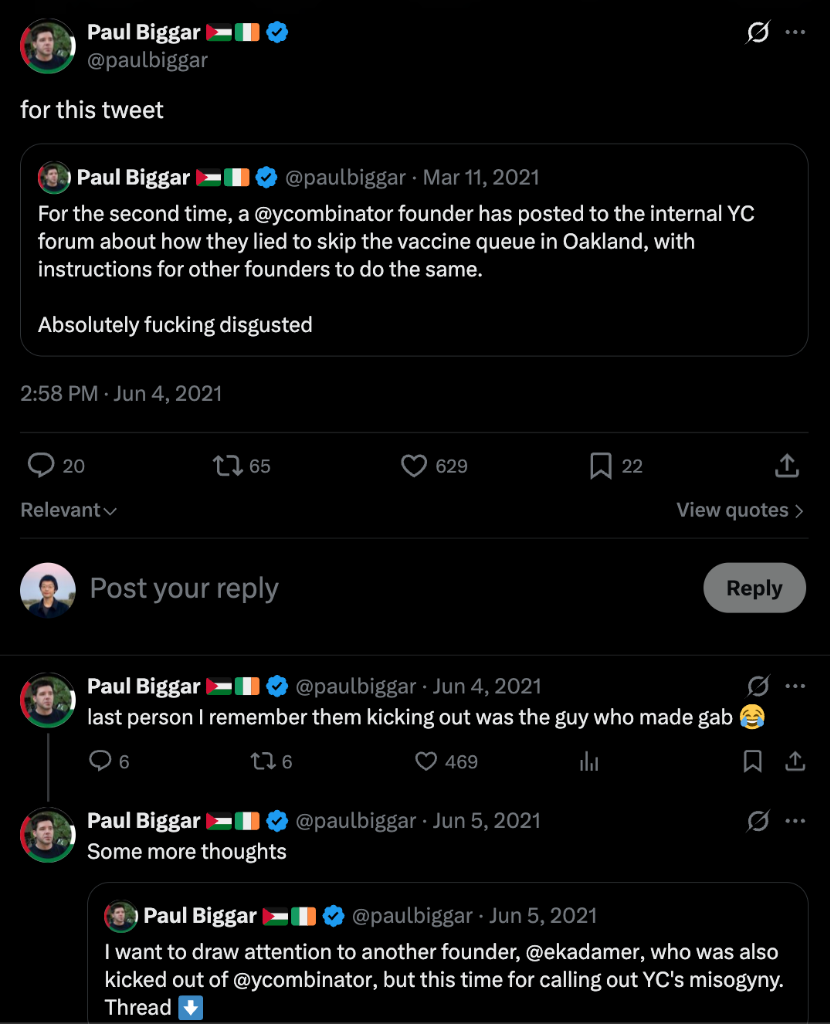
In March 2021, a YC founder posted on Bookface about bypassing vaccine eligibility restrictions and offered other founders tips on jumping the queue, including misrepresenting their circumstances. Biggar objected to this exercise of privilege and described it on Twitter. He shared no screenshots and did not identify the person. TechCrunch reported that YC removed him from Bookface for sharing internal information outside the community.
Bookface’s rule is clear: internal information must stay inside. But when that information is a tutorial on jumping a vaccine queue, what is confidentiality protecting? YC insisted on the community boundary. Biggar put public health first.
More than two years later, he took the same challenge to a wider circle. In his December 2023 essay “I Can’t Sleep”, he criticized technology leaders and investors for their silence and justifications during the war in Gaza. Some had invested in him and supported him. He named them in the essay, declaring that he would no longer seek funding from them or make introductions for them.
He subsequently founded and leads Tech for Palestine, continuing to speak up for Palestine. The Bookface dispute gave him no reason to hold back. He is willing to offend people over what he believes is right, and to keep working for it.
3. Ekaterina “Katia” Damer: The Battle of the Sexes
YC likes to describe itself as meritocratic and supportive of views that are unpopular but correct. Dr. Damer, co-founder and then-CEO of Prolific, was precisely such a woman founder who dared to speak out.
But when the status quo she challenged was Silicon Valley’s deep-rooted male-dominated culture, she discovered that YC’s inclusiveness had boundaries. YC admired her resilience as a woman scientist and her firm conviction in her mission, but that conviction made her unable to tolerate the misogynistic atmosphere within the community. As a result, she criticized not only an individual (the author of Chaos Monkeys), but the entire community’s indulgence of him, crossing the boundary of YC’s tolerance.
Damer’s conflict with the YC network was rooted in Silicon Valley’s gender dynamics. In May 2021, Apple hired Antonio García Martínez (a YC alumnus and founder of AdGrok). Almost immediately, Apple employees launched a petition calling for his dismissal on the grounds that they considered certain passages in his memoir Chaos Monkeys misogynistic. In his memoir Chaos Monkeys, García Martínez described women in the San Francisco Bay Area as “soft, weak, cosseted, naive,” contrasting them with the “lush, fertile” women he admired elsewhere. In 2021, this passage prompted Apple employees to petition for his dismissal, and Apple fired him within days.
The reaction inside YC to García Martínez was largely defensive of him. Some prominent alumni and partners viewed his dismissal as a victory for cancel culture and a loss of free speech, and the alumni network rallied to support him.
Damer refused to compromise. She published a post on Bookface titled Is YC an Inclusive Organization? If We Continue Like This, YC Will Lose Its Good Reputation, criticizing the YC network for defending García Martínez. She argued that defending such views would create a hostile environment for women founders within the YC network.
YC co-founder Jessica Livingston responded: “YC is not soul-searching.” This response received hundreds of likes, while Damer’s post received only a few. In anger, Damer posted screenshots of the conversation on LinkedIn and Twitter and withdrew all the praise she had previously given YC’s founders.
Less than two weeks after YC asked her to remove the screenshots, Damer was removed from Bookface. Her co-founder and Prolific remained in YC, and YC told Damer she could reach out if she wanted to re-engage. Asked whether she regretted speaking publicly, Damer said:
“People use rules when they don’t know what else to do. This is about courage, this is about actually standing up for what is right.”
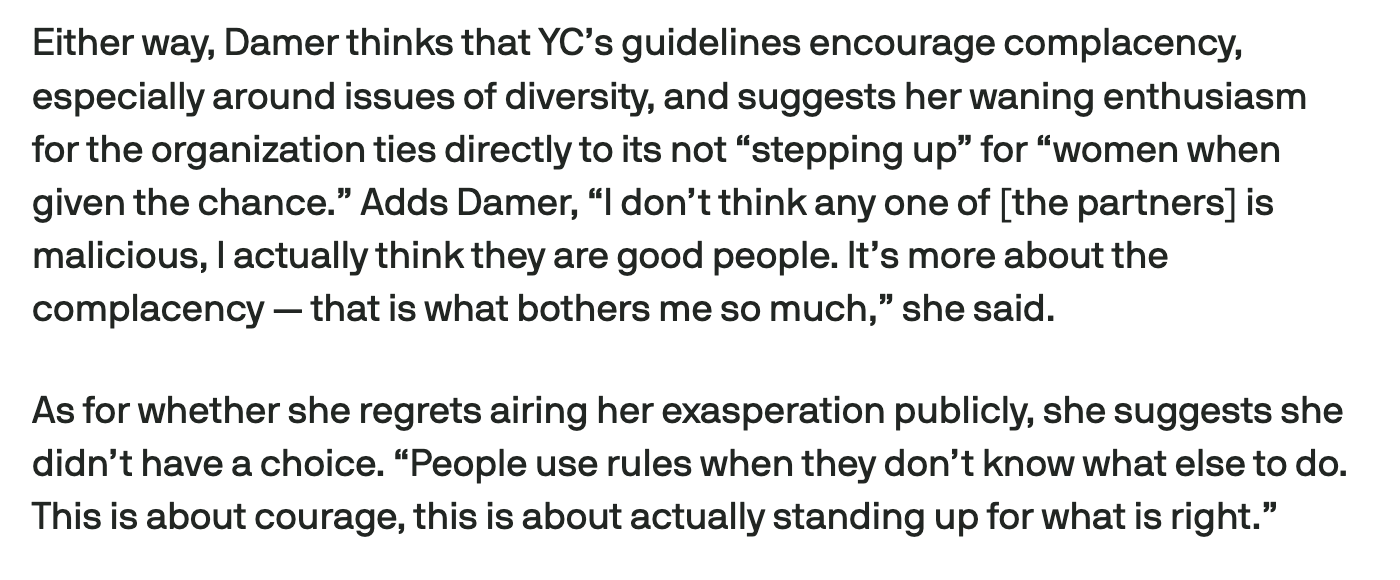
Damer’s removal highlights a crucial boundary in YC’s culture. Although the accelerator advertises its investment in women founders, its internal culture remains male-dominated and embraces liberalism.
YC tolerates unconventional male humor and behavior (often packaging it as high autonomy), but regulating that behavior is treated as cultural conflict or harmful conduct. In Damer’s view, her removal showed that YC placed the comfort of the majority group (men) above the safety and inclusion of the minority group (women).
4. Parker Conrad: Forced Out of Zenefits, Then Welcomed Back by YC
Conrad is the embodiment of the maxim “Move Fast and Break Things.” From Zenefits to Rippling, he has demonstrated extraordinary execution and an ambition to pursue growth at any cost. This is exactly the spirit Paul Graham champions.
He founded Zenefits (YC W13), a human-resources software company that grew faster than any SaaS company in history and reached a valuation of $4.5 billion in just two years. Its speed was simply like riding a rocket.
However, this ultra-fast growth also came at a cost. In 2016, Zenefits was revealed to have developed a software tool called “The Macro,” which allowed insurance brokers to evade mandatory state licensing requirements by leaving training modules running while they slept. Put simply, it let the system complete the training automatically so that people did not have to study it themselves. The resulting regulatory scandal forced Conrad to resign in disgrace. He faced fierce criticism from the media, the U.S. Securities and Exchange Commission (SEC), and his own board, including Andreessen Horowitz, commonly known as a16z.
Conrad went from star founder to a “radioactive asset.” He later described hiding at home while investors and crisis-PR firms shaped the story around him. But YC did not exile him: in a TechCrunch interview, Conrad said YC, Garry Tan, and other early investors backed him from Rippling’s earliest days.
According to the settlement announced by the SEC, in October 2017, Conrad agreed to pay a $160,000 penalty, plus disgorgement and interest; Zenefits agreed to pay a $450,000 penalty.
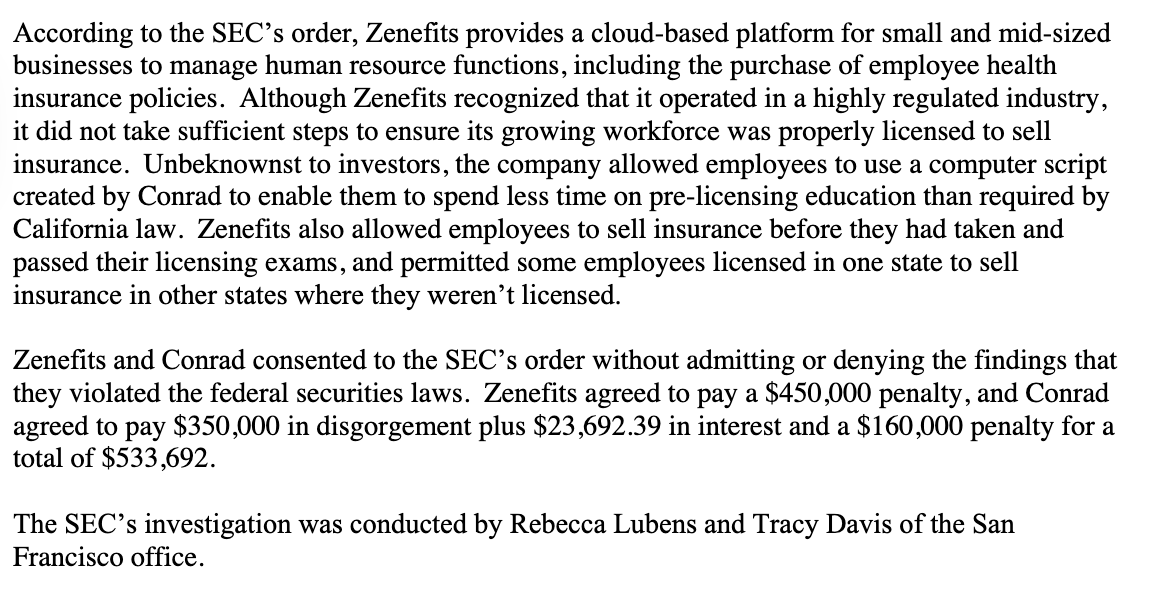
Conrad did not give up. He founded Rippling and took it through YC W17—his second YC batch after Zenefits. YC later publicly celebrated its growth, and Garry Tan interviewed Conrad in 2025. Axios covered his return to YC. Here are some interesting details:
- Compound startup: Conrad publicly criticized YC’s standard advice to focus on one thing. He argued that in B2B software, you need to develop multiple product lines simultaneously and form an integrated product matrix in order to build a compound startup that truly solves a company’s deeper needs, rather than making only a single-point tool.
- Success: Rippling raised funding at a $16.8 billion valuation in May 2025, higher than Zenefits at its peak, according to YC’s company profile.
- Proof of founder mode: In 2024, Paul Graham wrote an essay titled Founder Mode, inspired in part by Brian Chesky, but it resonated deeply with Conrad’s micromanagement style and rejection of professional managers’ advice. YC later publicly featured Conrad and Rippling and invited him to discuss compound startups.
5. Andrew Torba: The Political Exile
Torba participated in YC W15 (AutomateAds) and represents the absolute boundary of YC’s tolerance. In 2016, he became an outspoken supporter of Donald Trump. He later founded Gab, a social media network that advertised itself as a champion of free speech but became a haven for the alt-right and white nationalists.
YC once admired his courage to stand against the crowd and his vision of building an independent ecosystem. But when that opposition turned into concrete political hatred and online harassment, YC drew a line.
Torba was expelled from the alumni network in 2016. According to discussion records on Hacker News, Torba engaged in a heated argument with other founders in a Facebook discussion involving YC partner Garry Tan. He made the following explosive statement:
“All of you: fuck off. Take your morally superior, elitist, virtue signaling bullshit and shove it. I call it like I see it, and I helped meme a President into office, cucks.”
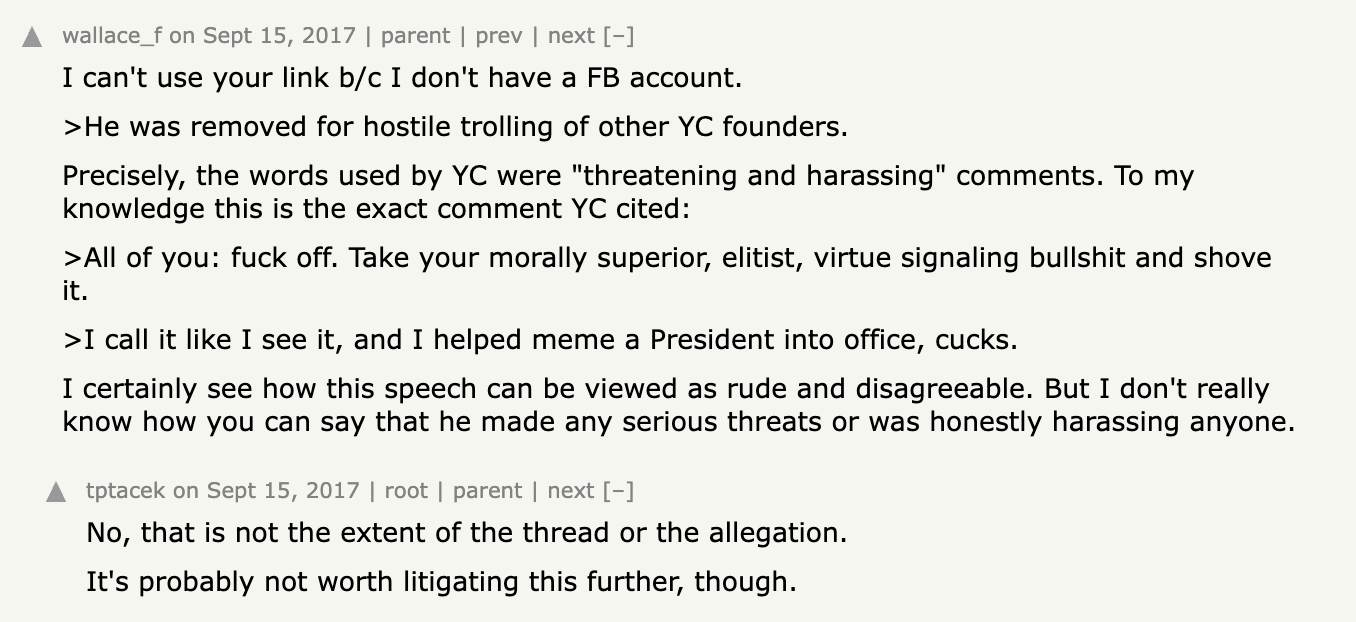
Sam Altman issued a statement clarifying that Torba was removed not because of his political position (supporting Trump), but because he violated the harassment policy. Altman wrote: “Unless you believe trolling is a protected political position… he was removed for malicious trolling.” After this, Torba fully embraced the identity of an exile and built Gab into a parallel economic alternative to the Silicon Valley technology stack.
This incident is a typical case of YC’s boundaries. Torba, however, believes that for conservatives, expressing their beliefs will be defined as harassment by the left, making this distinction meaningless.
Comprehensive Analysis: A Sociological Study of Shadow Alumni
The founders introduced in this article all share one trait: a high degree of autonomy. They are strong-willed, stubborn, and absolutely unwilling to compromise. These are precisely the important qualities YC looks for in applicants. The dramatic part is that when these traits turn back toward YC itself, YC’s defense mechanisms may strike back hard.
But the stories of the five “YC traitors” are not the same kind of paradox:
- Breck Yunits: Kept questioning how YC shares its profits and who gets to control public discussion after being removed from Bookface
- Paul Biggar: Took the vaccine-queue story outside the community and was removed from Bookface for violating YC’s confidentiality rule
- Katia Damer: Attracted YC by challenging the status quo, but was removed from Bookface after challenging sexism
- Parker Conrad: Made a startup comeback after a compliance scandal and was publicly welcomed back by YC
- Andrew Torba: Attracted YC through free speech, but was expelled for trolling
However, for none of them did removal, a reputational crisis, or parting ways with YC end their subsequent careers:
- Conrad built a larger company (Rippling)
- Biggar founded and leads Tech for Palestine, continuing his advocacy for Palestine
- Damer built a market leader (Prolific)
- Yunits preserved the purity of his ideas (Tree Notation)
- Torba built Gab into a highly controversial parallel platform
This shows that although YC’s network effects are powerful, they are not indispensable. In fact, for the most ambitious founders, Bookface’s closed circle may instead become a burden—it allows people to hear only insiders’ voices and prevents them from seeing opportunities in the outside world. Some left that network and kept going. Conrad walked back through the front door with Rippling.
The Rise of the “Anti-Elite”
We are witnessing the disintegration of Silicon Valley’s consensus. Shadow alumni are forming their own spheres of influence, which can be roughly divided into three categories:
- The moralists: Biggar and Damer—after leaving, they focused on human rights and fair-labor issues, defining the technology industry’s moral boundaries through action
- The independent: Torba—he chose to bypass Silicon Valley’s mainstream ecosystem, build his own platform and technology stack, and no longer rely on traditional gatekeepers
- The idealist: Yunits—he insists on prioritizing the pursuit of truth over commercial profit
For perceptive observers, these three groups represent different possible futures for the technology industry beyond the increasingly homogenized YC/Sequoia mainstream axis.
Conclusion
This paradox ultimately points to Y Combinator’s evolution: it is no longer merely a startup accelerator, but has become a mature institution with its own interests, community norms, and institutional loyalties.
It could even be said that YC is like a “miniature state” with its own rules; it too has its own dissenters, behavioral boundaries, and exiles. Founders like Yunits and Biggar may be the truest embodiment of the unmanageable hackers described by Paul Graham.
The dramatic part is that to maintain institutional stability, YC must manage the unusually independent founders it selected with its own hands. It is like parents teaching a child to think independently, but when the child truly begins to question the parents’ decisions, both sides must redraw the boundaries.
Bonus: Silicon Valley’s Radioactivity: Naval Ravikant
Although Silicon Valley legend Naval Ravikant is not a YC alumnus, his experience reveals the Silicon Valley elite’s attitude toward troublemakers.
Around 2005, Naval and other Epinions founders sued Benchmark Capital, August Capital, and a co-founder, saying that they had been misled in the Epinions transaction and that these VCs had deceptively induced the founders and employees to give up their equity when Epinions merged with Dealtime. Fast Company later reported that the lawsuit made his name “radioactive mud” in Silicon Valley, and it left almost no one in Silicon Valley willing to touch him.
But Naval did not disappear. He transformed this experience of marginalization into a deep understanding of venture capital’s power structure and founded AngelList in 2010, a platform intended to break the VC monopoly and allow ordinary people to invest in startups too.
Today, Naval Ravikant has become one of Silicon Valley’s most influential and popular investors and thinkers. His Twitter account has millions of followers, and his thoughts on wealth, happiness, and the philosophy of life are regarded as guiding principles. The VCs who once considered him “radioactive” now compete to work with him. The transformation from “radioactive mud” to a hot commodity is certainly dramatic.
To understand innovation fully, one cannot focus only on the celebrated alumni on the Demo Day stage; one must also pay attention to these exiles shut out by the server. It is precisely through the price of their expulsion that they define the system’s boundaries.
Marginalization by the elite is not the end, but may be a new beginning. True rebels will not be defeated by the system; they will create new systems. Sometimes, being kicked out is instead the best beginning.
Thanks to Breck Yunits, Paul Biggar, Yuxuan Cao, Xiangliu, Chonghao Su, Sean Xiang, Roderick Dong, Haowen Xia, Shaodong Liu and others for reading and commenting on drafts of this.
References
- Paul Graham:
- Breck Yunits:
- Paul Biggar:
- Katia Damer:
- Parker Conrad:
- Andrew Torba:
- Naval Ravikant: